If you’re uncertain about where to start with resume writing in Australia, or your existing resume isn’t getting interviews, don’t be discouraged. With a few key strategies, you’ll reposition yourself with a standout resume for the Australian job market.
Even the most experienced professional can struggle with the frustration of trying to break into a new market. It is likely that you don’t lack the experience relevant for the Australian market, but rather that as an internationally experienced candidate, your resume isn’t effectively translating your experience. This makes it more difficult for an Australian hiring manager to immediately understand your value.
Supporting migrants with high-calibre resumes is something I’m personally passionate about. It’s where I first began my own resume-writing career more than 14 years ago. Growing up in a migrant family, I deeply appreciate how challenging calling a new country home is. I also know how wonderful life in Australia can be – if you can only secure those initial career breaks you need.
So, in this blog, I’m sharing my top takeaways for translating your international experience into a quality resume for the Australian market.
1. Lead with Your Skills & Capabilities in Resume
Your resume should not feel apologetic for having primarily or all international experience. A skills-first resume confidently owns and sells your capabilities, so the recruiter is immediately anchored to the value you have to offer, over the location you gained your experience in.
Reimagine your resume as not merely a chronological recap of career history, but rather a pitch for your capability. Make your transferable skills clearly visible in your resume before expecting the recruiter to interpret your career history.
To write a skills-first resume, integrate references to your specific capabilities from Page 1, specifically in your:
- Value Proposition
- Key Expertise profile (4-5 categorised skills)
- Actions described or implied in your Select Achievements
Let’s explore, for example, showcasing skills in the Key Expertise profile for the resume of a Marketing Manager. Instead of one of your 4-5 skills reading:
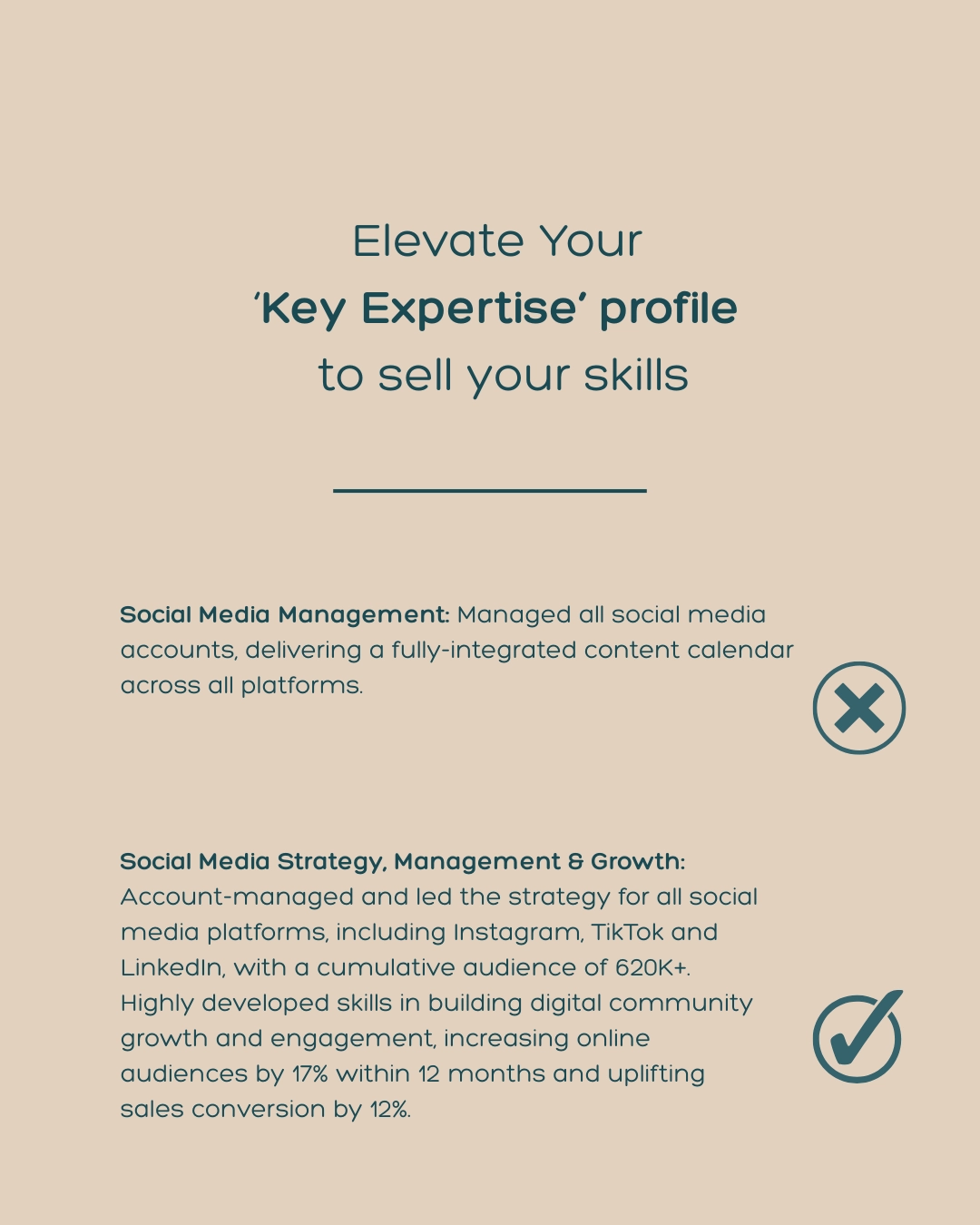
“Social Media Management: Managed all social media accounts, delivering a fully-integrated content calendar across all platforms.”
You might instead say:
“Social Media Strategy, Management & Growth: Account-managed and led the strategy for all social media platforms, including Instagram, TikTok and LinkedIn, with a cumulative audience of 620K+. Highly developed skills in building digital community growth and engagement, increasing online audiences by 17% within 12 months and uplifting sales conversion by 12%.”
Whether the audience is familiar with the business or not, it shows:
- Capabilities
- Scope
- Scale
- Results (engagement and commercial)
At Elevate Career Services, for both our local and internationally experienced clients, we design and develop Page 1n of your resume to act as a self-contained pitch. It should leave the reader wanting to interview you before they have even read the rest of your resume. At the very least, it should compel them to read on and learn more about you.
2. Write an Evidence-Based Resume
With some similarities to the US and UK job markets, high-calibre Australian resumes are now strongly evidence-based. In many cases, demonstrated capability and achievements carry more weight in your resume than qualifications do – though Australia does still value this as well.
It’s not enough to simply sell your skills in your resume. Without evidence, the claims you make about your skills lack substance. By adding evidence to your resume, you provide proof points for the impact that applying those skills has had through your career.
The dot points that accompany each role you’re showcasing in your resume should not read like the responsibilities of your job description, but rather as highlights. For example, for a Human Resources leader, this might read:
“Redesigned the national training and incentive programs for 320+ retail staff. Established a self-funding system that elevated staff capabilities and rewarded performance through structured online and in-person education, with values-led performance tracking, increasing overall staff retention by 48% within 1 year.”
Here you are showcasing your results in your resume, while also conveying some of the actions involved, for example:
- Establishing a commercial strategy/budget
- Designing training and incentive programs
- Developing online and in-person formats
- Performance measurement/management
Note, if you are applying for federal or state government jobs, the Australian Public Service follows a highly structured approach to recruitment. This ensures candidates are assessed on merit, with a strong focus on the ‘STAR’ model. For government applications, along with your resume, you might be asked to submit one of the following, while addressing the selection criteria:
- Pitch
- Responses to targeted questions
- Cover letter
- Statement of Claims
In government recruitment, this generally holds more weight than your resume. However, your resume should clearly align with the requirements of the role.
For more on the Australian Public Service (APS), see these links.
- APS – Cracking the Code
- APS – Integrated Leadership System (ILS)
- APS – Values & Code of Conduct in Practice
State governments have their own individual systems and capability frameworks:
- NSW Capability Framework
- VPS Capability Framework
- ACTPS Capability Framework
- QPS Capability Framework
- WA Capability Framework
For more on government job applications in Australia, see my earlier blogs:
- How to Decode Selection Criteria: A Step-by-Step Guide for Australian Job Seekers
- How to Write Standout ‘STAR’ Examples in Key Selection Criteria for Government Job Applications
If you need assistance with government applications, you can also explore our selection criteria and pitch services here.
3. Align Your Resume to Local Lingo
As an internationally experienced candidate in the Australian job market, don’t overlook the importance of nuances in our local language. A quality job application should be carefully customised to the role. For each application:
- Review the job advertisement and job description thoroughly. Copy and paste these into a word processing program if needed.
- Highlight all the relevant language and references
- Compare this to your resume and adjust your language, including any acronyms, accordingly
This isn’t about deceiving the recruiter by including experience in your resume that you don’t have. It’s about being aware that some countries may value calling the same skills different things or that other markets might use different industry lingo. Your resume should show you understand the Australian market.
4. Context & Worldbuilding in Your Resume
Experience within Australia is not a pre-requisite for your resume. However, if you are relying solely on international experience, you must build trust in your resume around not only your capabilities but the key organisations you have worked for. Remember that unless you have worked for a global or multinational business, it’s unlikely that a hiring manager in Australia will be familiar with the brands presented in your resume. This means you must more actively establish role and institutional credibility wherever possible.
You can highlight the scale or industry standing of the business across:
- Role blurbs: Up to three lines opening each role, included before the dot-pointed highlights. This should paint the picture of the scope of your responsibility or remit, quantify the scale where relevant and communicate a purpose.
- Business one-liners: Italicised and/or slightly smaller reference underneath the company name where you list the role in your resume.
- Page 1. References in your Value Proposition, Select Highlights and/or Key Expertise.
The purpose of this is to bolster the professional branding in your resume with a value proposition that is immediately understandable to the recruiter irrespective of their knowledge of the employer brand. I’d liken this to worldbuilding in storytelling. Your resume isn’t simply telling the reader what you did. It’s giving them enough context to understand the world you did it in.
So, how would you describe your role to someone who did not know where you came from?
For example, consider:
- Is the business the largest service provider in the industry in that country?
- Is the company the top-ranked brand in the state/territory or country?
- What is the turnover of the business?
- Is the business a publicly listed organisation?
- How many staff does the business employ?
- What is the scope or geographical scale of the business?
- Does the business have a premium or cutting-edge offering in its market?
- Has the business been recognised through industry awards?
Sometimes we are too close to where we have worked to easily articulate the value proposition for our employer brand to a third party. A quick Google of the business will usually show you how the marketing team clearly sells the strongest elements of the organisation’s value proposition. Remember, your target employer shouldn’t be expected to Google your former employer themselves to understand your value. Give them enough context in your resume to make the connection clear.
5. Spotlight Your Australian Experience in Your Resume
One way to reduce uncertainty about your ability to adapt to the local market is by highlighting your Australian experience as a priority in your resume.
For example:
- If this was your most recent experience, list it first in your Professional Experience section
- Integrate references to experience within Australia into Page 1 of your resume
If you haven’t gained any professional experience within Australia yet, consider, where applicable, highlighting:
- Australian qualifications, quality courses or study in progress
- Australian volunteering or community engagement
While you may not feel your contributions in Australia are as significant as your international experience, this still serves an important purpose. When a recruiter is reviewing the resume of an internationally experienced candidate, there is the added complexity of the recruiter being less familiar with your previous environment. They have less context for how your experience will translate in an Australian workplace culture. By showing you have already had working, professional, academic or community-centred relationships within Australia, you’re demonstrating your ability to establish relationships with others locally.
Remember your resume isn’t the place to overly communicate your migration story either. This will likely naturally evolve in interviews (which, we also offer interview coaching services for).
If you have had Australian experience, your resume should address your international experience, without presenting an overly internationally-branded profile. Though as an exception to this, your international profiling or impact may be more relevant if you are applying for an Australian-based role with strong international scope. In which case, these references form a key part of your career branding strategy. Otherwise, you aren’t hiding your international experience – it is valuable. You’re merely being strategic about how and what is presented in your resume.
6. Spotlight Your Australian Experience in Resume
If you’re wondering how you have room for a self-contained Page 1 pitch, 2-3 line role highlights and more, this brings us to perhaps one of the most notable differences in formatting for an Australian resume. A two-page resume can seem like a great benchmark for communicating clearly and succinctly. However, in Australia there is no universal convention that you must fit your resume within two pages – a popular approach in some other countries.
The Australian hiring culture is conditioned to value your resume for the capabilities it communicates, the quality and relevance of what’s included, rather than arbitrary page count guidance. That said, you should always pay special attention to the guidelines in the advertised role.
When our team at Elevate Career Services are working with clients, we always prioritise:
- Streamlining your document, including strategies for best presenting multiple roles
- A harsh edit where needed to strengthen the target profiling, preventing less relevant references from diluting your positioning
- Rewriting your documents entirely from scratch as succinctly as possible
- Moving roles as appropriately into a more condensed Early Career section.
That said, simply for the sake of page count, we don’t cut anything that adds value.
At Elevate Career Services, we frequently create three-page resumes where the additional content strengthens the document. In some instances, depending on your career history, role highlights or the extent of your Education and Professional Affiliations, this may even be up to 4 pages, provided it adds genuine value.
While the Australian market might be a little more lenient when it comes to longer resumes than some of our international counterparts, you should also show that you value the recruiter’s time. Remember, even in Australia, recruiters are likely only skimming your resume, at least at first glance. Plus, bear in mind that the best and most effective communication can usually say more by saying less. So only include what needs to be included in your resume.
Internationally experienced candidates will sometimes bring common formatting conventions into the Australian market. For example, in some international markets, photos are common, qualifications may be most prominent or personal details might be openly shared.
These format considerations, which may differ from some other markets, are worth noting:
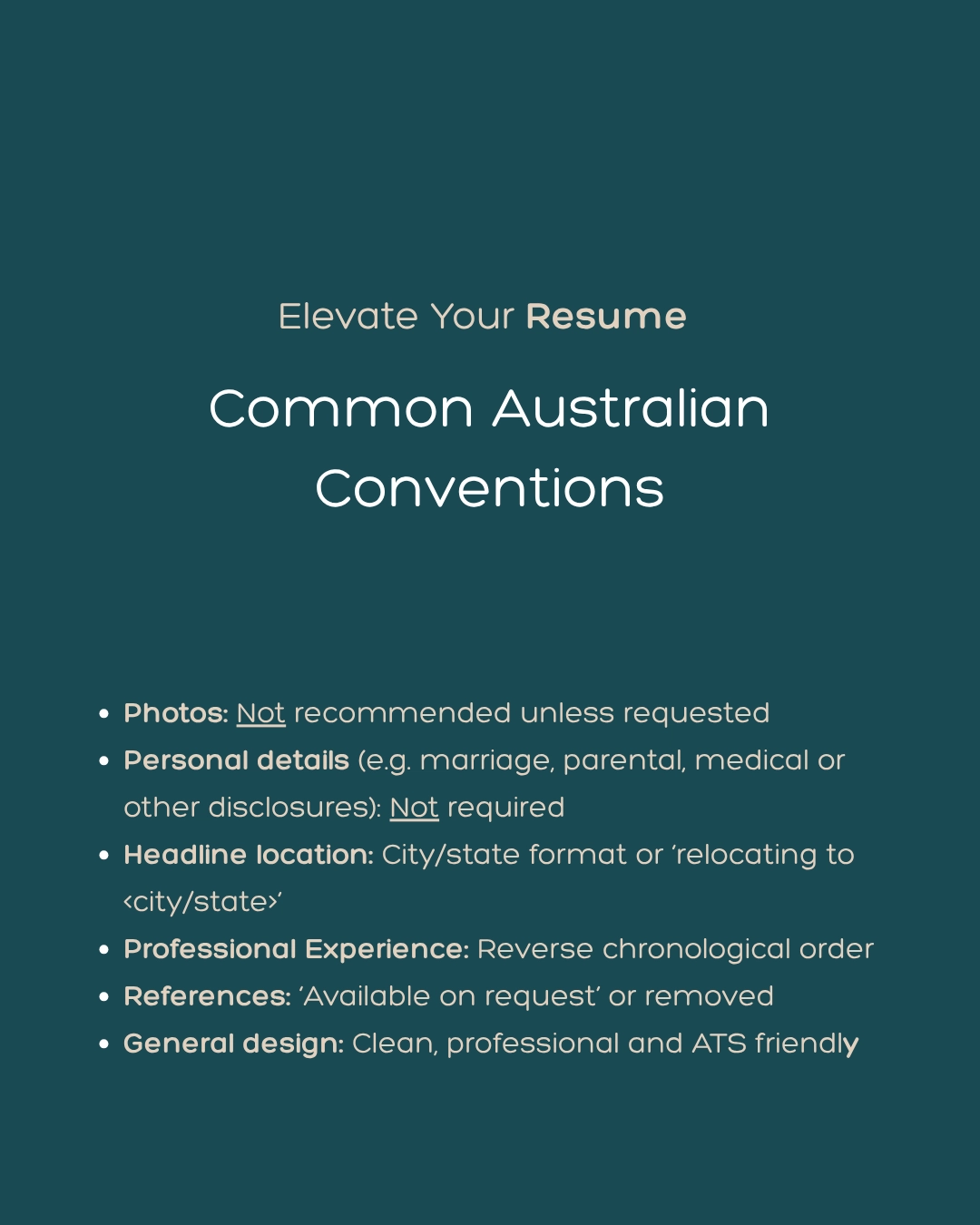
- Photos: Generally not recommended unless requested
- Personal details (e.g. marriage, parental, medical or other disclosures): Not required
- Headline location: City/suburb, state format will suffice, or e.g. relocating to Sydney, NSW’
- Professional Experience: Reverse chronological order
- References: ‘Available on request’ or can be removed altogether as this is assumed.
- General design: Clean, professional and ATS friendly
For a comprehensive set of essential templates, see our Job Search Bundle – Your Ultimate Digital Toolkit.
Regarding working rights, at Elevate Career Services, we recommend including this as a small reference, if at all, at the end of your resume. This helps prevent creating an immediate subconscious bias by highlighting this as the very first impression of your resume. We aim to sell your skills, experience and value first before we address working rights. This ensures your working rights are clear, while not becoming the headline of your professional profile. Additionally, many application forms themselves will address these as part of mandatory screening questions, so you don’t need to highlight this further in your resume.
Write Your Resume for Internationally Recognised Value
Your international experience isn’t something you have to shy away from or apologise for. Instead of a timid resume-writing style, enter the Australian market boldly and proudly. You don’t lack the relevant experience. The key is ensuring that an Australian hiring manager who doesn’t understand the environment you came from can easily recognise your transferable value.
Learn more about our resume writing services here or contact us to set up a brief discovery call directly with me.