

Your career break doesn’t define your career; it’s merely a footnote in it. Learn how to communicate a gap in your resume while showcasing your market-ready value.
Whether you took time off for family commitments, study, wellbeing, travel or other reasons, communicating your career break is not something to apologise for. The key is communicating any “gaps” in your resume with confidence, to control the narrative and redirect attention toward your capabilities, industry-ready skills and the impact you have in a role.
While a career break may leave you feeling a little less confident than you may have been used to in your career, perceptions of career breaks are evolving. According to Forbes, after engaging over 500 hiring managers in the USA, LinkedIn found that 67% are now more likely to hire someone who has taken a career break than before the pandemic. Both employees and hiring managers are rethinking time off.
I touched on career breaks in my recent blog, 11 Resume Red Flags: The Simple Mistakes That Could Be Costing You Interviews. Now, let’s deep dive into how to communicate them well, so you can feel confident about any time away and your transition into your next career opportunity.
1. Transparently Communicate Your Career Break in Your Resume
Don’t make the mistake of leaving your career break off your resume altogether. Hiring managers are hardwired to quickly skim your resume, looking for patterns. Your career break isn’t the problem; it’s an unexplained gap in your resume that pops on the page to recruiters.
When you don’t address your career break openly, hiring managers are left with their imaginations, drawing their own uninformed conclusions. By proactively addressing a career break in your resume, you answer more questions than you raise.
To communicate your career break succinctly and clearly in the Professional Experience section of your resume, here are a few one-line examples:
- [Career Break: Caregiving Jul 2025 – Present]
- [Career Break: Parental Leave Jul 2025 – Present]
- [Career Break: Travel Jul 2025 – Present]
- [Career Break: Wellbeing Jul 2025 – Present]
- [Career Break: Full Time Study: MBA Jul 2025 – Present]
Right-align the dates component with the other dates listed in your Career Overview or Professional Experience.
2. Reframe Your Time Away Appropriately in Your Resume
At Elevate Career Services, we partner with many clients who describe themselves as being on a “career break” when, in reality, they have still been building their professional experience. For example, they may have been growing a business or working as a consultant or contractor. Don’t assume that because you’ve had time away from the traditional full-time roles you’re used to, that this should automatically be labelled as a career break. For example, if you engaged in project work, position this as a role within your resume, for example:
- Graphic Designer | Freelance | Sydney, NSW Oct 2025 – Present
- Management Consultant | Contractor | Melbourne, VIC Jan 2026 – Present
- Project Manager | Contractor | Brisbane, QLD Jan 2026 – Present
Your professional value can come in many forms. If you’ve been advancing your skills and experience, don’t dilute your professional development. If you have engaged in any continuous learning while on your career break, such as through courses, training, certificates, conferences, community engagement, include these in the Professional Development section of your resume and add this to the narrative in your Value Proposition.
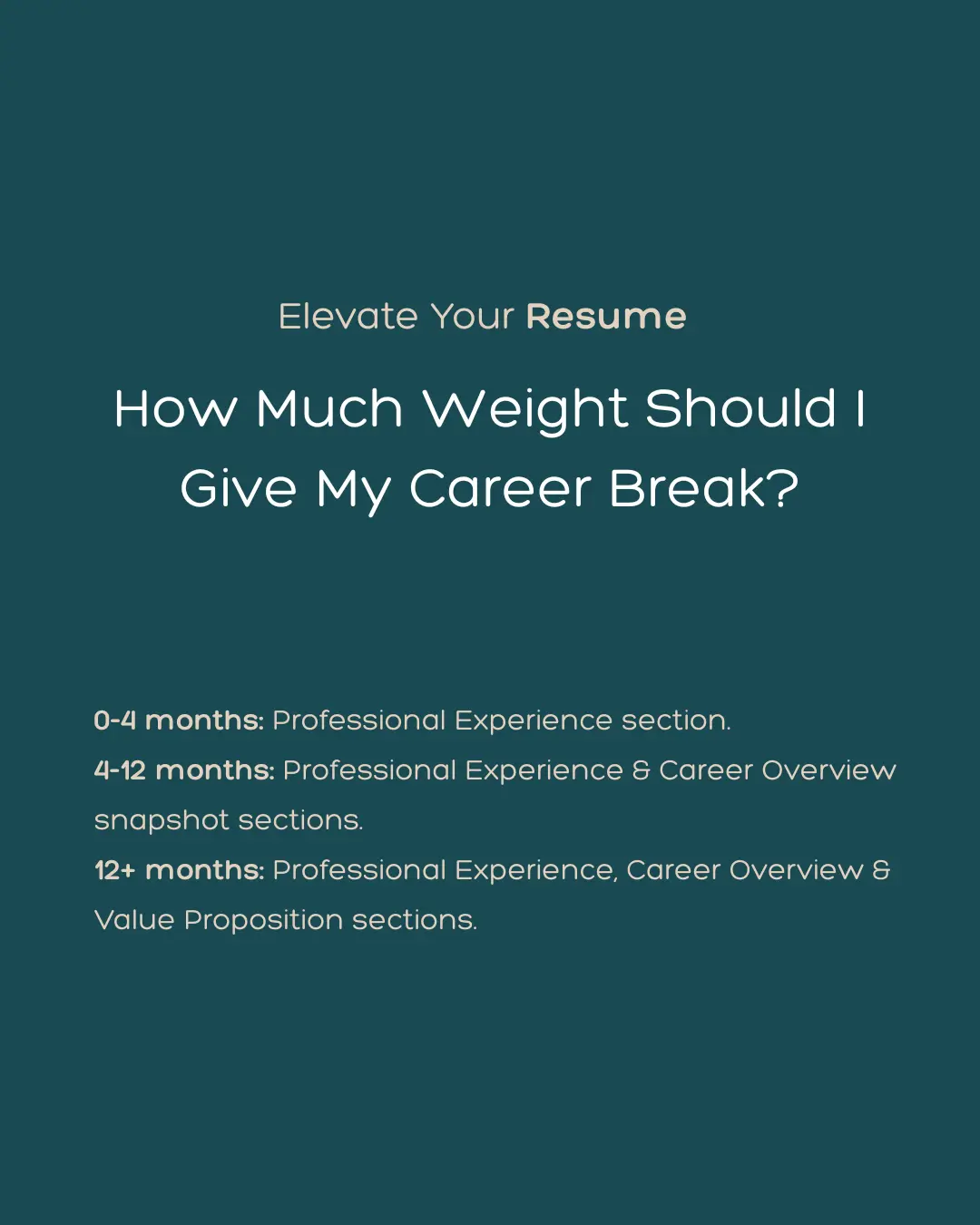
3. How Much Weight Should I Give to My Career Break?
Not all career breaks need to be communicated equally. How extensively you communicate a career gap depends on how much time you took off. Here are some general guidelines:
- 0-4 months: Professional Experience section.
- 4-12 months: Professional Experience and Career Overview snapshot sections.
- 12+ months: Professional Experience, Career Overview and Value Proposition sections.
4. Disclose in Your Resume Without Distracting: Tactful Formatting
While you’re adopting the mindset to communicate your career break transparently, don’t overcommunicate your career break either. As you communicate your career and capabilities with confidence in your resume, don’t feel the need to defend your career break. Your career breaks should be communicated clearly without distracting from the value in your resume.
To prevent your career break from overpowering your resume, use the following writing and formatting tips:
- Value Proposition: Communicate your capabilities before your career break. Don’t lead with your time off.
- Career Overview Snapshot & Professional Experience: Italicise your career break one-liner and drop the font size down a size or two.
Being tactful about the formatting in your resume isn’t about hiding your career break, but rather creating a visual and reading hierarchy. A few considered choices direct the reader to your skills and experience first. It immediately anchors the hiring manager to your value.
5. Sell Your Skills First in Your Resume
With selling your value first in mind, your career break isn’t the headline; it’s the footnote in your career history. Writing key sections of your resume skilfully will showcase your capabilities. Here are some tips for writing a skills-first resume:
Value Proposition (Page 1): Include key skills and industry experience in the opening hook of this section, for example:
- “I am a senior Human Resources (HR) specialist with 10+ years of experience, driving high-impact people and culture, safety and training development strategies across the mining and FMCG sectors.”
Select Achievements: (Page 1): 3-5 one-liners featured before your Key Expertise or Career Overview snapshot, highlighting cumulative career achievements or specific projects/outcomes, for example:
- “10+ years of Human Resources leadership experience gained across BHP, Rio Tinto and Woolworths Group.”
Key Expertise: (Page 1): 3-5 categorised skills, each with 2-3 sentences, communicating further highlights, achievements or career capabilities, for example:
- “HR Team Leadership – Lead, mentor and influence teams of up to 10 staff including people and culture, safety and training specialists across the ANZ Region. Member of several regional committees, including the national WHS, and training and development forums.
Professional Experience ‘Role Highlights’: Dot points within each featured role of your achievement-oriented outcomes, showing the impact you’ve had in the roles, for example:
- “Spearheaded the roll out of inaugural ANZ leadership program as a 12-month initiative for 20 high-potential emerging leaders, elevating the talent pipeline and future-focused succession planning.”
6. A Forward-Focused & Connected Narrative Across Your Application
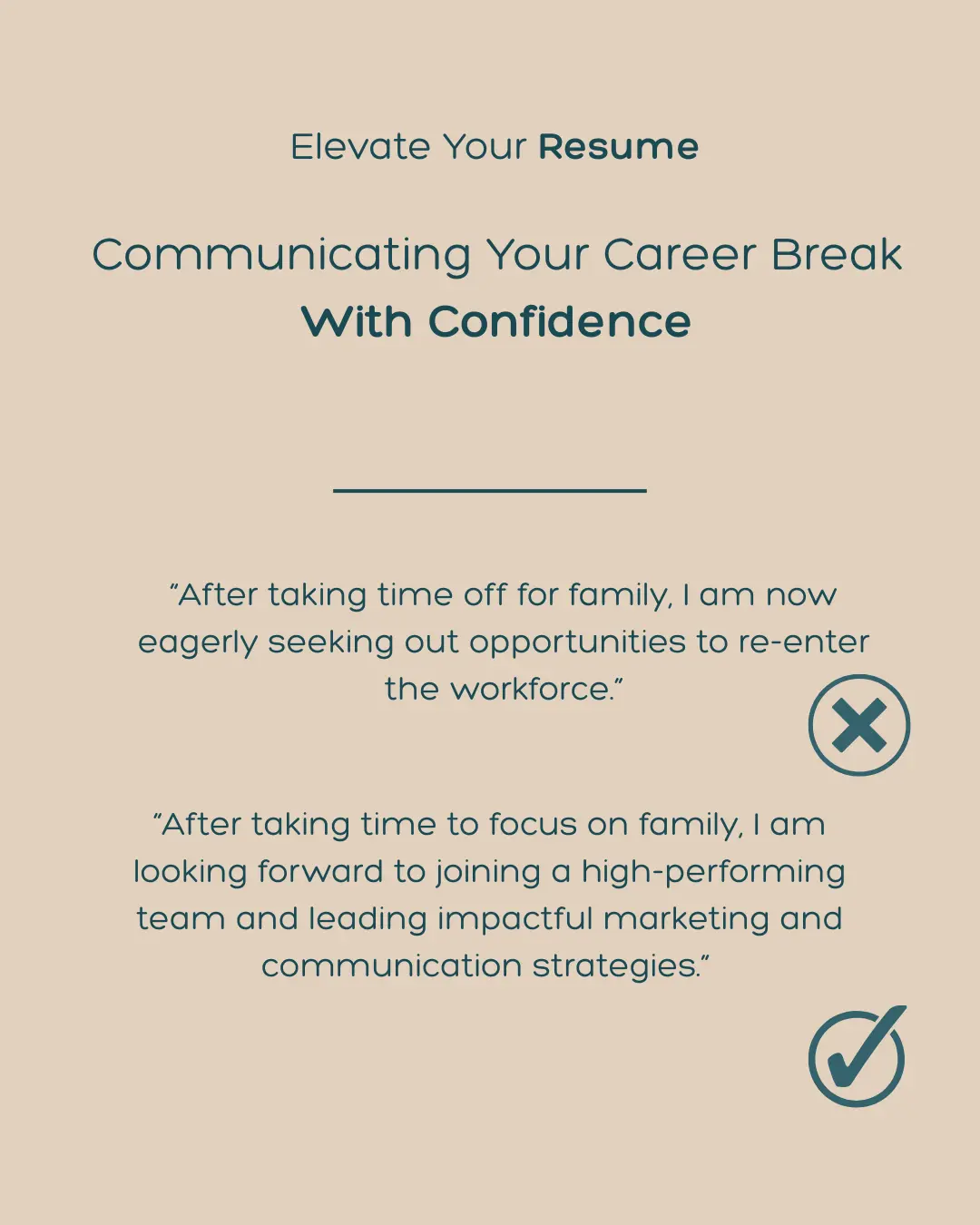
Your career break should also be consistently communicated in the cover letter for your applications. Compared to your resume, you have a little more real estate in your cover letter to communicate a career transition. That said, don’t overexplain your career break in your cover letter either. Your career break can be communicated with clarity in a simple sentence or two. For example, toward the closing of your resume, you might write:
- “After taking time to focus on family, I am looking forward to joining a high-performing team and leading impactful marketing and communication strategies.”
- “Prioritising my professional development full-time, I have recently completed an MBA and am looking forward to applying this industry-ready knowledge to a new leadership role.”
If you aren’t confident crafting your cover letter for your re-entry into work, our team at Elevate Career Services can help. Learn more about our cover letter writing services here.
Remember, most recruiters are also searching your social media as part of the recruitment process. Ensure your LinkedIn profile is consistent with your resume to elevate your credibility. Check that all dates are aligned with those featured in your resume.
LinkedIn also allows you to Add Career Break in the Experience section of your LinkedIn profile. You also have the option to add a Type to your career break. Select the most appropriate choice from the following:
- Bereavement
- Career transition
- Caregiving
- Full-time parenting
- Gap year
- Layoff/position eliminated
- Health and well-being
- Personal goal pursuit
- Professional development
- Relocation
- Retirement
- Travel
- Voluntary work
You can also add a Description to your career break. Use this section only if you are simply communicating anything that adds further context or value to your professional positioning. For example, if you took time off for Professional Development, state what courses or training you completed.
P.S. If you’re newer to the world of LinkedIn or want to elevate your professional presence across all platforms, see our earlier blog, How to Write a Professional LinkedIn Profile (With Personality): LinkedIn is the New Business Card. You can also learn more about our LinkedIn profile services here.
Stay Up-to-Date With the Latest Resume Writing Trends
Depending on how much time you’ve had away in your career or when you last had to write a resume, what constitutes a modern-day resume may have evolved. For a quick recap on everything you need to know about how to write a resume in 2026, see our earlier blog, Resume Writing Trends to Know in 2026: What’s Outdated, Here to Stay & New.
Communicating Your Career Break with Clarity & Confidence
Don’t shy away from any time you’ve taken off in your career. When you communicate your career break openly, yet without overexplaining, you immediately answer potential recruiters’ questions and control the narrative of your career story. Be transparent while spotlighting your impact and industry-ready capabilities.
We understand that navigating career breaks or extended time away from work can be challenge, for assistance writing a marketplace-ready resume, contact us.


