

Your LinkedIn profile is often one of the first things recruiters and potential contacts use to decide whether or not to connect, so write a LinkedIn profile with substance and style.
With a few brief words, a traditional business card would tell people what you do and how they can contact you. Now, LinkedIn is the new first impression in professional networking. Potential contacts are likely searching for your profile before they meet you. Plus, overwhelmingly so, hiring managers are checking it during the recruitment process. It’s the digital handshake that tells people how you think, what you value and how you impact an industry.
A standout LinkedIn profile isn’t simply your title and a landing page for your LinkedIn account. It’s social proof. It’s your professional positioning, which, when done well, also shows the character you bring to your role.
At Elevate Career Services, our team has written hundreds of LinkedIn profiles across all major industries, ranging from early career and management, all the way up to executives of global icons. No matter what your industry or role, a few key principles for writing a standout LinkedIn profile remain. Let’s break them down:
1. Start with an SEO Strategy for Your LinkedIn Profile
Before you put words to your LinkedIn page, begin with a simple Search Engine Optimisation (SEO) strategy. Your LinkedIn profile’s SEO makes you discoverable to the right people. While you know your professional experience inside out, LinkedIn must be trained to understand where you fit in the big scheme of its 1 billion+ global user community. Strategic keywords tell LinkedIn who you are and who to connect you to.
Your SEO strategy shouldn’t overwhelm you. Start with your skills.
Skills-First LinkedIn Profiling
According to LinkedIn insiders, skills are the new hiring currency. Recruitment decisions, which were once centred on formal education and job titles, are evolving. In what LinkedIn’s Chief Economic Opportunity Officer, Aneesh Raman, calls the ‘Innovation Age’, skills-first hiring is more important than ever. By focusing on employees’ skills, more so than their work history, recruiters are positioned to add 20 times more qualified workers to talent pools.
Skills-first hiring is already reflected in LinkedIn trends, with a consistent rise in job posts that don’t require a degree. More people are focused on potential than pedigree. In this rapidly evolving marketplace, if recruiters aren’t hiring for skills, they’re hiring for obsolescence. If you want to get recruiters’ attention, tell them what’s in it for them. Sell the skills they’re seeking most.
Spotlight your future-focused skills
It’s said that 70% of the skills that were needed for the average job in 2015 will be different by 2030. When writing your LinkedIn profile, it’s easy to stay stuck in the past. But if recruiters are hiring for potential, be sure to demonstrate your future-focused abilities. Show how your capabilities will usher a business into a new era. You don’t simply follow trends. You understand the market and set the pace in the industry.
Writing Your LinkedIn Profile to Align with Industries: Finding Your People
Simply stuffing your LinkedIn profile with skills isn’t going to award you connections on LinkedIn. Plus, ‘keyword stuffing’ upsets most search engines. It also sounds unnatural to the reader. Choose strategic over stuffing. For example, you’ll give your skills greater value by aligning with relevant industries.
Examples for how to write LinkedIn skills strategically:
- Marketing -> Sports Marketing
- Project Management -> Engineering Project Management
- Automation -> Financial Services Automation
The closer relevant keywords and phrases are together, the stronger your SEO strategy.
Targeting Titles on LinkedIn
Help LinkedIn and hiring managers make sense of your experience. What’s more important than your past titles are the titles you’re targeting. So, with your keywords in mind, identify:
- Your target role/s, considering alternative terms recruiters use.
- How can you integrate these words? Even if you’ve haven’t held the title yet, weave these into other areas of your profile.
Example for how to target title variations, alternate between:
- Head of Marketing, Marketing Director, Senior Marketing Manager, CMO
While alternatives are a consideration, as is keyword repetition. Ensure you’re repeating the most important phrases.
Example for how to target titles (without experience in them)
- You’re an engineering graduate, yet to hold your first role: Still weave Engineering Graduate or engineer student through your profile.
Your profile is more than the roles you’ve had in the past. It’s your expertise, skills and potential. There are plenty of places to spotlight your value in line with your target jobs.
2. How to Sell Your Skills in Your LinkedIn Profile
One of the best places to start putting your SEO strategy and professional positioning on the page is in your Skills sections.
Pinpointing Your LinkedIn Top Skills
Your 5 Top Skills appear at the top of your LinkedIn profile. They set the tone for your LinkedIn profile visitors. When writing your Top Skills:
- Identify the skills/industries most aligned to your professional positioning and value proposition.
- Combine phrases for related concepts where relevant, to optimise the real estate.
- Avoid repetition, saving each spot for a unique value-adding skill.
- Move your most important skills to the top. Remember, readers have a primacy bias.
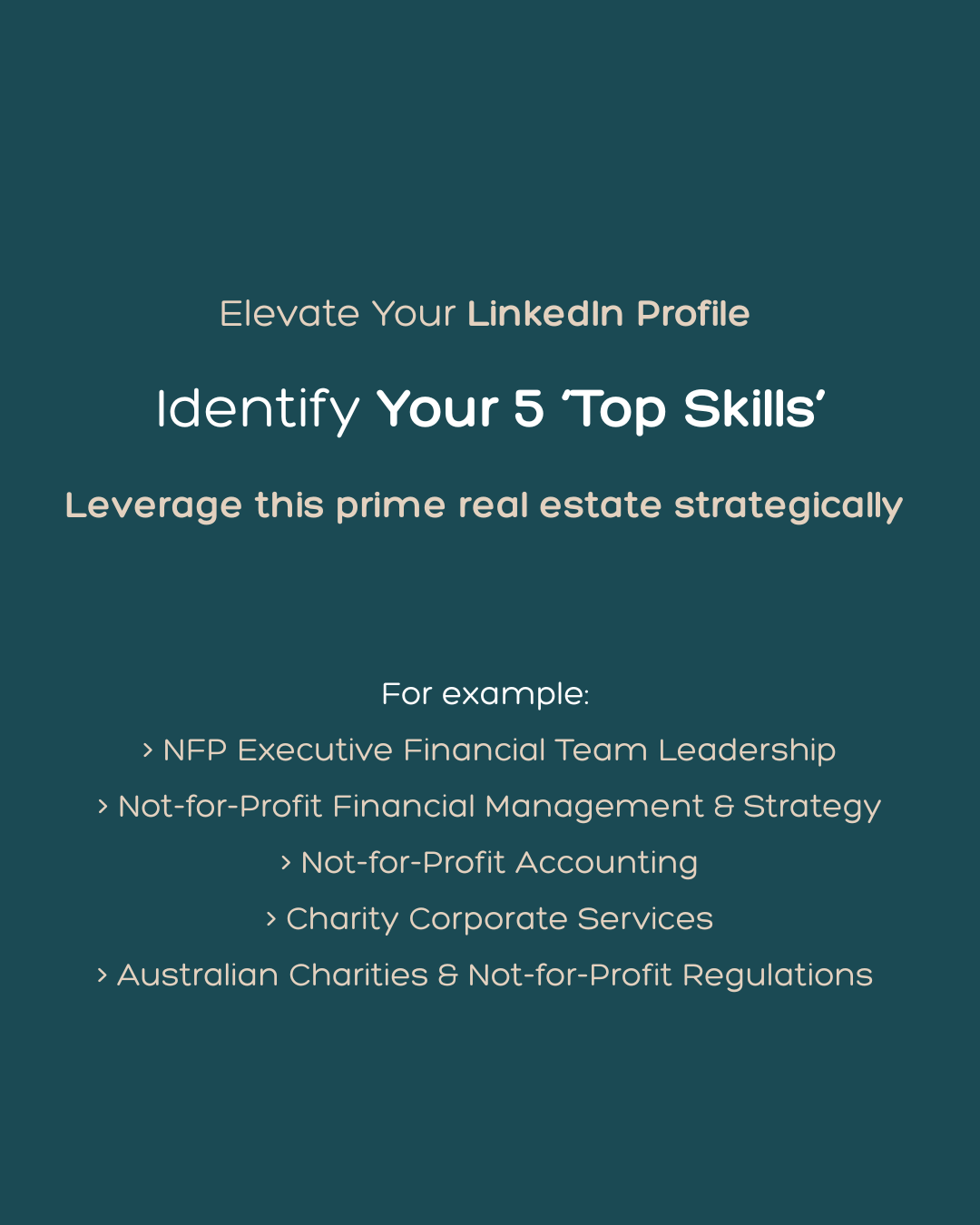
Examples for how to write Your Top Skills:
- NFP Executive Financial Team Leadership
- Not-for-Profit Financial Management & Strategy
- Not-for-Profit Accounting
- Charity Corporate Services
- Australian Charities & Not-for-Profit Regulations
Putting Your Best Skills Forward on LinkedIn
Whatever doesn’t make the Top 5 cut can be added to your Skills section. LinkedIn allows up to 100 skills listed here. It only previews the first few skills, so it won’t overwhelm your profile. Maximise the opportunity to align with keywords, including alternate phrasing for related ideas.
This doesn’t mean you have to use all 100 spots. When you confuse them, you lose them. Avoid listing vague skills that dilute how you communicate your professional positioning to LinkedIn. Sticking to what’s unique to your target positioning will only strengthen your profile. Edit with discernment.
3. How to Optimise Your Professional Experience on LinkedIn
As they say, the best design isn’t always what’s added, but what’s taken away.
LinkedIn allows you to add 2,000 words to each role description. But just because you can, doesn’t mean you should. Many professional LinkedIn profile writers will jam-pack your LinkedIn profile with dense descriptions, in a bid to prove their value and stuff your profile with keywords. Meanwhile, the best LinkedIn profiles ensure the right words do the heavy-lifting for you. Most importantly, they are written for the human reader who is:
- Skimming
- Time-poor
- Wants keywords to jump out, not have to dig for them
Only write descriptions for the roles most relevant to your target role. It enhances how LinkedIn understands your professional positioning. Plus, for the human viewer, it spotlights only the most relevant roles.
How to structure each role description on LinkedIn:
- A brief blurb: 1-2 sentences showing the primary purpose of the role, written with keywords in mind.
- A few select brief dot points: Show results and impact while also aligning to keywords.
- Data points: Give the eyes something to land on.
- Symbols: Add visual interest e.g. ► using simple symbols as dot points.
- Skills: Attached via the skills you listed in your Skills section.
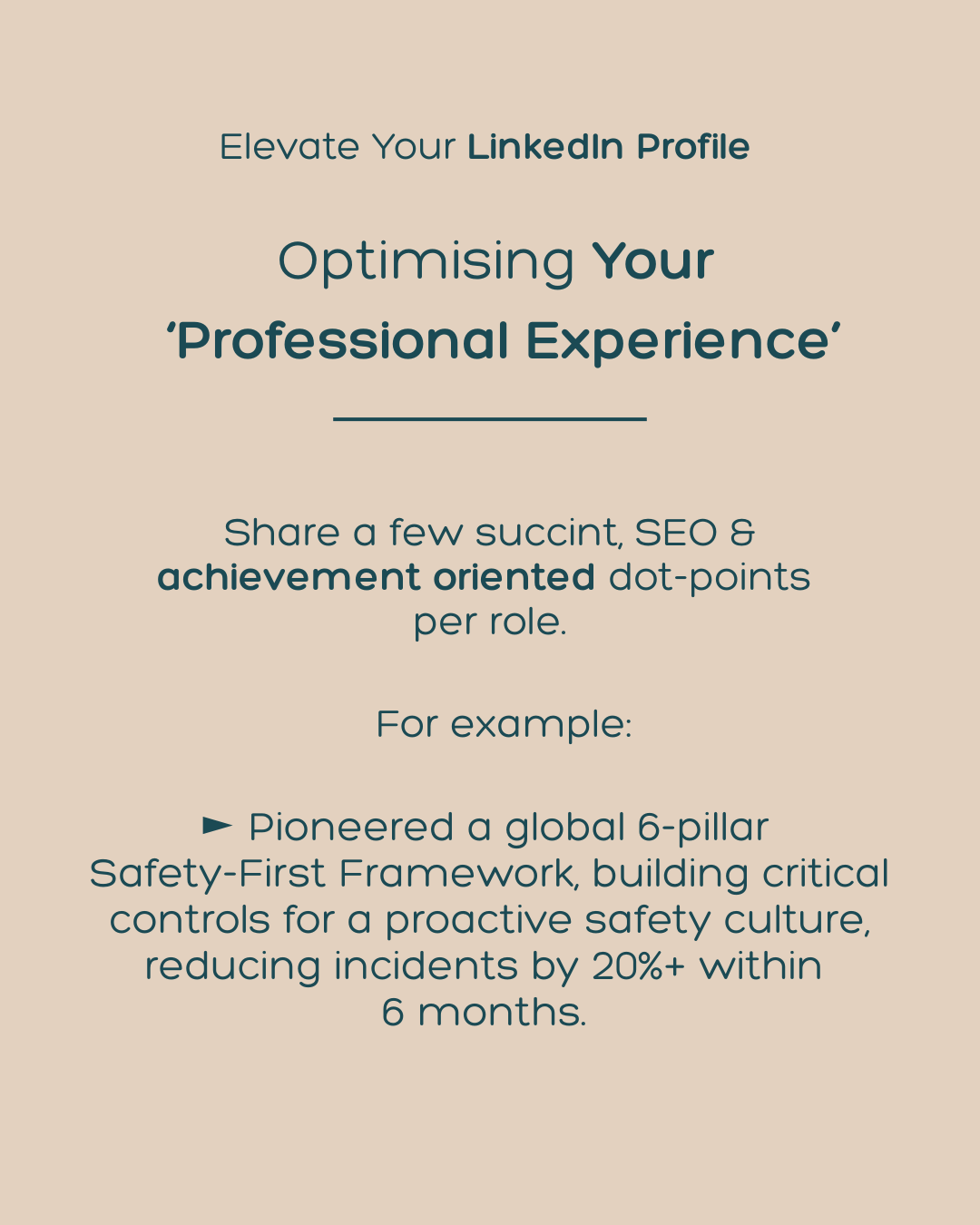
Example for how to dot point your professional experience:
► Pioneered a global 6-pillar Safety-First Framework, building critical controls for a proactive safety culture, reducing incidents by 20%+ within 6 months.
Bonus Tip: You don’t need to give it all away on your LinkedIn profile. Reserve some of your resume gold strictly for recruiters during the hiring process. This ensures your resume delivers extra value beyond your LinkedIn profile, plus it is a place to communicate more confidential details.
If you need assistance writing your resume, learn more about our resume writing services here. We offer packages including resume writing and LinkedIn profile writing. You may also choose to add cover letters or government selection criteria, too. With a standout LinkedIn profile, you never know when an opportunity might come knocking.
4. Writing Other Sections on Your LinkedIn Profile Wisely
Optimise your LinkedIn profile across relevant areas of your LinkedIn profile, including your
- Education
- Licenses & Certificates
- Volunteering
- Courses
- Honours & Awards
- Projects
- Organisations/Associations
- Language – Tip: If you speak a language other than English, include English as well.
Use the real estate of your LinkedIn profile wisely. Your resume might group certain information. For your LinkedIn profile, consider strategically splitting up information that may elevate the skimmability of your LinkedIn profile and draw attention to details that are otherwise easily lost.
For example:
- Split your courses, certificates and degrees across relevant headlines, instead of overwhelming your Education section.
- Add speaking engagements or committee/Board members to Organisations/Associations instead of under role details.
- Write initiatives with industry-wide impact into your Projects section rather than in position descriptions.
- Use your Volunteering section to add personal character, while considering your target roles.
A few simple placement choices can change how a viewer on your LinkedIn profile experiences your unique value proposition.
5. How to Write an About on Your LinkedIn with Personality: Communicating Your Career Story
Your About section is where the magic happens for adding character to your LinkedIn profile. Compared to your, at times, overly formal resume, it’s where your personality can really come to life.
Viewers on your LinkedIn profile aren’t just judging your skills. They’re asking themselves, “Do I like this person?” and “Can I see myself or my teams working with them?”
Writing Your LinkedIn Profile Hook
Like all good copywriting, sharpen how you write your LinkedIn profile with a compelling hook for your About section. For a hook that leaves readers wanting more:
- Don’t bury the lead.
- Show immediate alignment to key skills and industries.
- Remember, LinkedIn only previews the first few lines.
- Show a sense of purpose. How you work contributes to something bigger than the task at hand.
Example for how to write a LinkedIn About hook:
“I am a Civil Construction Project Manager with 10+ years of experience delivering high-value government projects across infrastructure, water and transport, driving future-focused community outcomes.”
Share Storytelling on LinkedIn
Humans are hardwired for storytelling. It lights up our brains and, as neuroscience shows, makes facts more memorable. Even just a few lines of storytelling written into your LinkedIn About can instantly make you more relatable, build connections, and sow the seeds of trust.
The proliferation of AI may have democratised copywriter secrets and delivered near-perfect grammatical correctness. But it has also made many LinkedIn profiles sound robotic. Storytelling adds the personality and value only you can bring to a role.
Here are some simple storytelling ideas for a LinkedIn profile:
- Your origin/founding story: How you came to do what you do
- A mentor story: What you learned that shaped the way you think and operate
- A turning point: A catalyst for a career pivot
- Personal philosophies: Mantras or mindset shifts you’re known for
- A career highlight: A defining moment in your career
You have 2,200 characters to leverage. While the goal is quality over quantity, dedicating a few lines to storytelling can instantly shift the tone of your profile. Move from feeling like there is a piece of glass between you and the reader to speaking like you’re right there in the room with them.
For example:
“My career in construction was paved early. I grew up learning the secrets of stellar projects through our family business. While the other kids were working casually in fast food and retail, I spent my summers on construction sites, shadowing Dad and learning to think like a Project Manager – and all their many stakeholders”.
If you don’t want to rely on your writing skills, let our team do the storytelling for you. When you engage us for a LinkedIn service during your one-to-one consultation, your writer will listen to your story and prompt you for what will make your personality pop on the page for your profile. Our team of experienced writers, consultants and strategists will make you feel right at home sharing your story.
Choose a More Conversational Tone on LinkedIn
A more relatable profile calls for more attention to your tone – or less, depending on how you look at it. While your resume is polished for professional writing, a standout LinkedIn About should come across as more conversational. LinkedIn is a social network platform after all.
A well-written About will sound more like how you speak naturally. Colloquial writing, used with discretion, is right at home here. References to your skills and industry experience will organically balance this, so it doesn’t lean a little too relaxed.
Add a Call to Action
Don’t get so swept up in storytelling that you forget to punctuate your profile with a call to action. If LinkedIn is the new business card, potential contacts do still need a gentle nudge to connect. As all good branding understands, don’t assume what to do next is obvious to your audience. Being explicit about your openness to connect or to be messaged opens the lines of communication.
6. How to Write a High-Impact Headline for Your LinkedIn Profile
Whether your potential contacts are scrolling through their recommended connections or land on your profile, your title is one of the first things they see.
For a high-impact headline in a skills-first market, elevate your LinkedIn headline from a generic title to a memorable, unique value proposition. Remember, you are more than your current title with your current employer. This is the title bestowed upon you – your borrowed authority. Don’t forget your industry authority, which is the real value you offer a marketplace overall. Your headline should highlight the latter.
SEO
When crafting your headline, consider your SEO strategy to target key skills, specialisations and industries. It doesn’t matter what you do in your current role; it’s your expertise that counts.
Formatting Your LinkedIn Headline
If you’re maximising your 220-character count, you’ll likely have a text-heavy headline. Break up key details using caps variations, symbols or emojis. Aim to draw the eye across your headline to encourage your viewer to keep reading.
Creating a Sense of Purpose
As they say, people don’t buy what you do, they buy why you do it. Titles and skills are quick wins for credibility, while a purpose-driven LinkedIn headline adds personality to your LinkedIn profile. A mission-led mindset also communicates the transformational state your work delivers – the impact you have in a role. It shows you’re results-driven and understand how your role fits into a bigger picture.
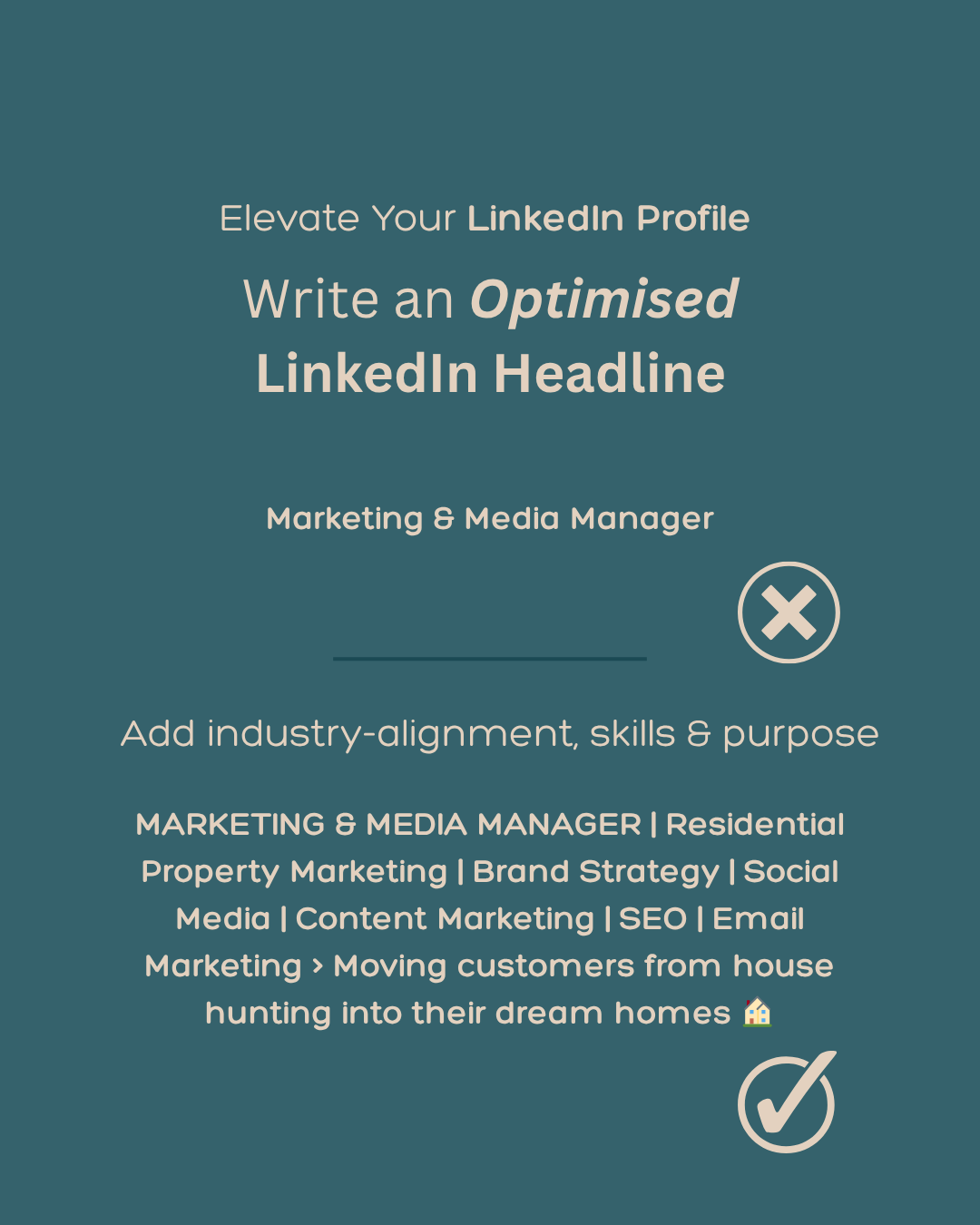
Using these tips, let’s transform this headline:
- ‘Marketing & Media Manager’
Example for how to write an optimised LinkedIn headline:
- MARKETING & MEDIA MANAGER | Residential Property Marketing | Brand Strategy | Social Media | Content Marketing | SEO | Email Marketing > Moving customers from house hunting into their dream homes 🏠
7. Wrap Up Your LinkedIn Profile Writing in More Memorable Packaging
You can write the perfect words for your LinkedIn profile, but the first impression of you is formed within milliseconds by the look and feel of your profile. The overall branding of your profile is the shop front window of your personal brand. Create an inviting experience that compels potential contacts to visit your profile.
Your LinkedIn Profile Photo
Pick a profile photo that is professional and clear. Ask yourself, “Will this profile picture attract or detract my target viewer?”
With a few simple clicks in Canva, you can easily transform a dull image taken on your phone into a bright and picture-perfect asset for your personal brand.
Your LinkedIn Profile Banner
Sticking with the default background banner of your LinkedIn profile is a missed opportunity. A customised banner behind your profile photo can not only drive engagement, but also show your passion for your industry. Your LinkedIn banner is more than decorative, so design it with purpose. Focus on at least one of these objectives:
-
- Emotive storytelling: An image-based banner to show, not tell.
- Value Proposition: A tag line to highlight your impact.
- Call to Action: An invitation to connect via LinkedIn or through other platforms.
- Personal Brand: A chance to put your name in headlights as a professional brand.
You can design your LinkedIn banners using templates available in Canva. If you’re not confident in your creative skills, let us do the designing for you.
At Elevate Career Services, as part of our LinkedIn services, we’ll design three banners for you to choose from, to make sure we capture the look and feel of your personal brand just right.
Transform your LinkedIn profile from lacklustre to inviting
LinkedIn is not the place to relax on your professional positioning. With more recruiters and industry players, using the platform to research your personal brand – often even before they’ve picked up the phone or met you – ensure your LinkedIn profile communicates the unique value you offer the marketplace.
To learn more about our LinkedIn profile writing services, contact us.


