

Writing your resume to navigate a career transition as a police officer, paramedic, firefighter or from the defence force can be a challenge. But the best resume will move your mission-led mindset into the right new role for you.
Through 10+ years of resume writing experience, I’ve learned that resumes for professionals transitioning out of law enforcement, ambulance services, fire and rescue, and the Australian Defence Force (ADF), require strong strategic finesse. From my experience delivering high-calibre, high-converting resumes for clients across these fields, here are my top tips for writing a resume that transitions your career from first responder to your first civilian role. One that values and sells the skills and experience you have already spent so much time building. Because you’re not starting from scratch, you’re organically evolving to the next stage of your life and career.
1. Connect the Narrative: Sell Your Unique Transferable Skills in Your Resume
You are more than your uniform. You add value to a team or organisation in a way that transcends your title. As our resume writers are everyday civilians, we have immense respect for the contributions our first responder clients have made to protecting and serving the community. That said, we see your capabilities – your unique value proposition in the civilian job market – beyond the lens of you being a first responder. Remember, your skills are transferable. More than that, they are likely exceptional.
If you are navigating a career change, your resume doesn’t need to read like you’re starting over. Instead, connect the narrative. Show how where you have been positions you perfectly for where you’re going. Your next step isn’t an abrupt career change. It’s a natural evolution or pivot. No matter what circumstances have led you here, your resume should read as though this is what your skills and experience have been building toward. When writing your resume, your ‘Key Expertise’ profile is the perfect place to ‘package’ your skills. Connect the dots for the recruiter. Help them do the mental heavy-lifting of making sense of the skills in your resume.
Hard skills to write into your resume
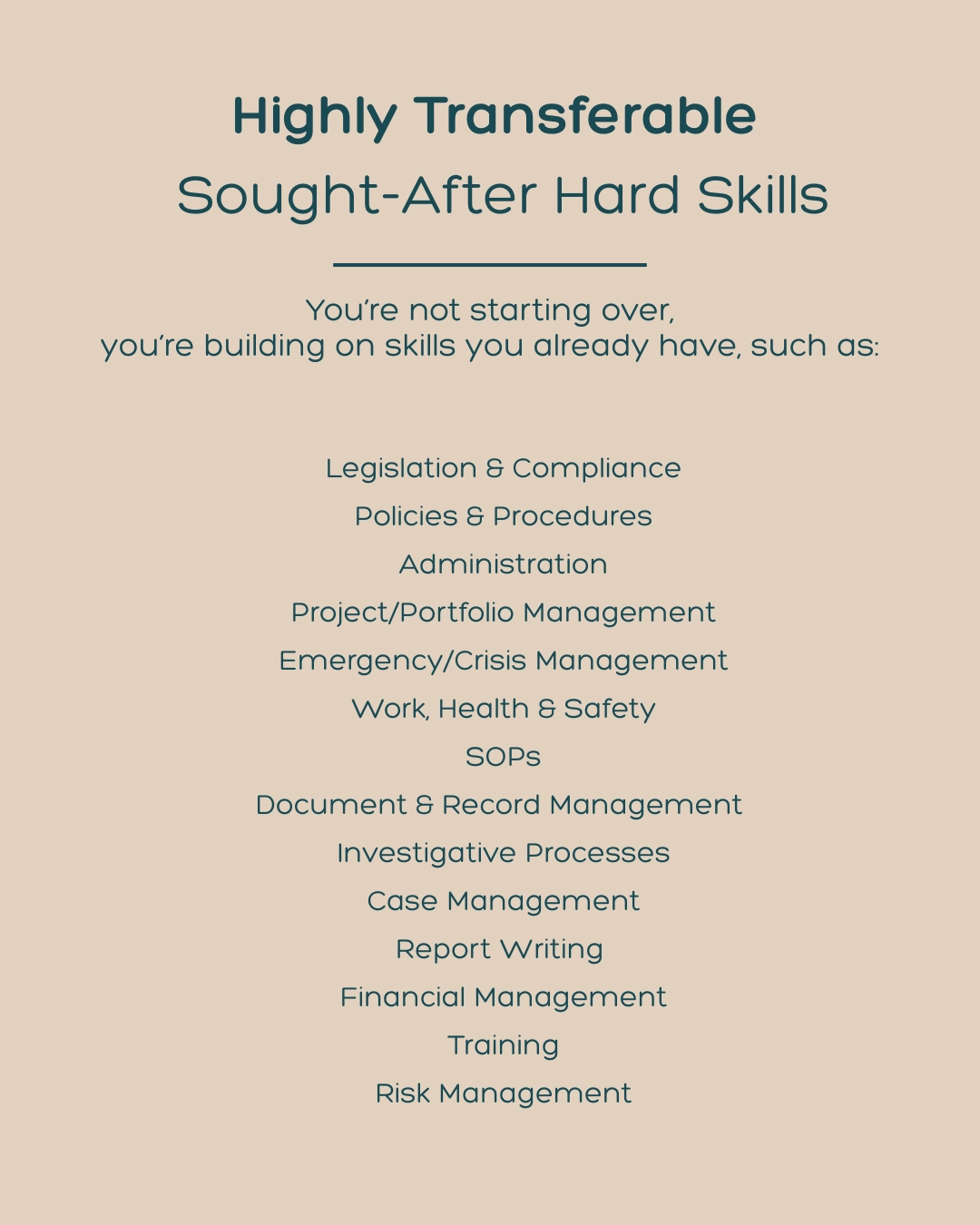
Hard skills in your resume showcase to a hiring manager your specific, measurable abilities. They add tangible and verifiable content to your resume. Before you discount your hard skills as being irrelevant to a civilian role, think again. The hard skills you have gained in your experience across enforcement, ambulance services or fire and rescue are uniquely valuable. Moreover, you’ve likely built a rare combination of these skills developed at an elite level. When writing your resume, hone in on sought-after hard skills, for example:
- Legislation & Compliance
- Policies & Procedures
- Administration
- Project Management
- Portfolio Management
- Emergency Management
- Crisis Management
- Work, Health & Safety
- SOPs
- Document & Record Management
- Investigative Processes
- Case Management
- Report Writing
- Financial Management
- Training
- Risk Management
- Audits
The hard skills you choose to highlight in your resume will depend on your target role. Align with what is most valued for your professional positioning moving forward.
Showcase soft skills to write a resume that stands out
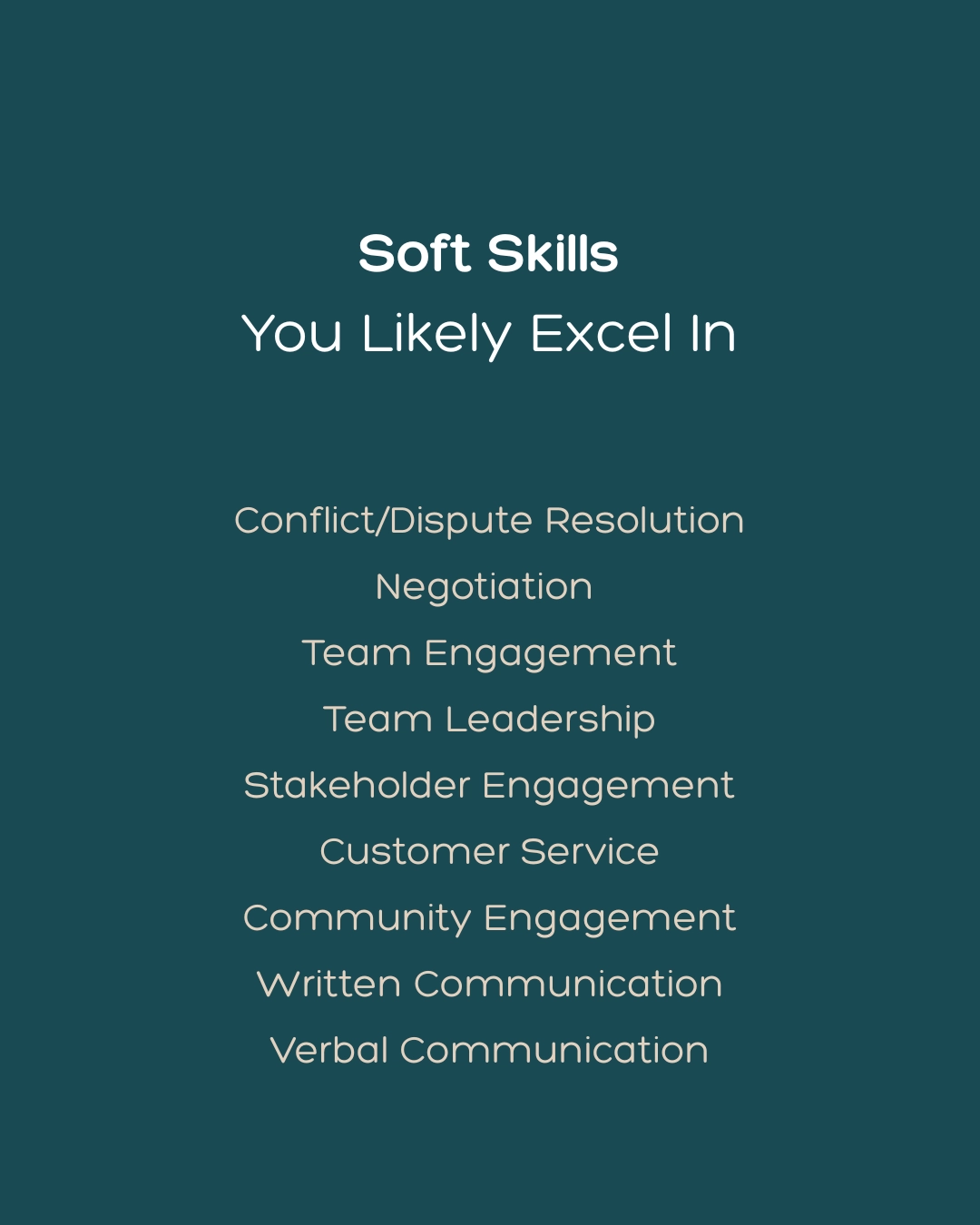
The hard skills you highlight in your resume most often draw direct links to your technical capabilities. They showcase what you can do. However, the soft skills in your resume also importantly sell your unique value. They show how you do it. Here are a few ideas for featuring soft skills in your resume, you likely already excel at:
- Conflict/Dispute Resolution
- Negotiation
- Team Engagement
- Team Leadership
- Stakeholder Engagement
- Customer Service
- Community Engagement
- Written Communication
- Verbal Communication
First responders from the state police forces to the Australian Federal Police (AFP) and Defence front lines are exceptionally placed to handle high-pressure situations with poise, calm and composure. When writing your resume, your Key Expertise and your role highlights can be leveraged to showcase your ability to perform under pressure. You understand politically charged or sensitive situations well. You have a demonstrated ability to maintain the highest professional standards when the stakes are high.
Outside of the force, ambulance or fire services, nearly all civilian roles have their own inherent versions of potential tension or conflict. As a transitioning first responder, this is where the character you bring to a role can shine. You’re naturally positioned to de-escalate conflict, listen actively, communicate assertively, yet with empathy, and unite others. Weave these abilities through your resume writing.
Evidence-based claims: Demonstrate your professional value in your resume with proof
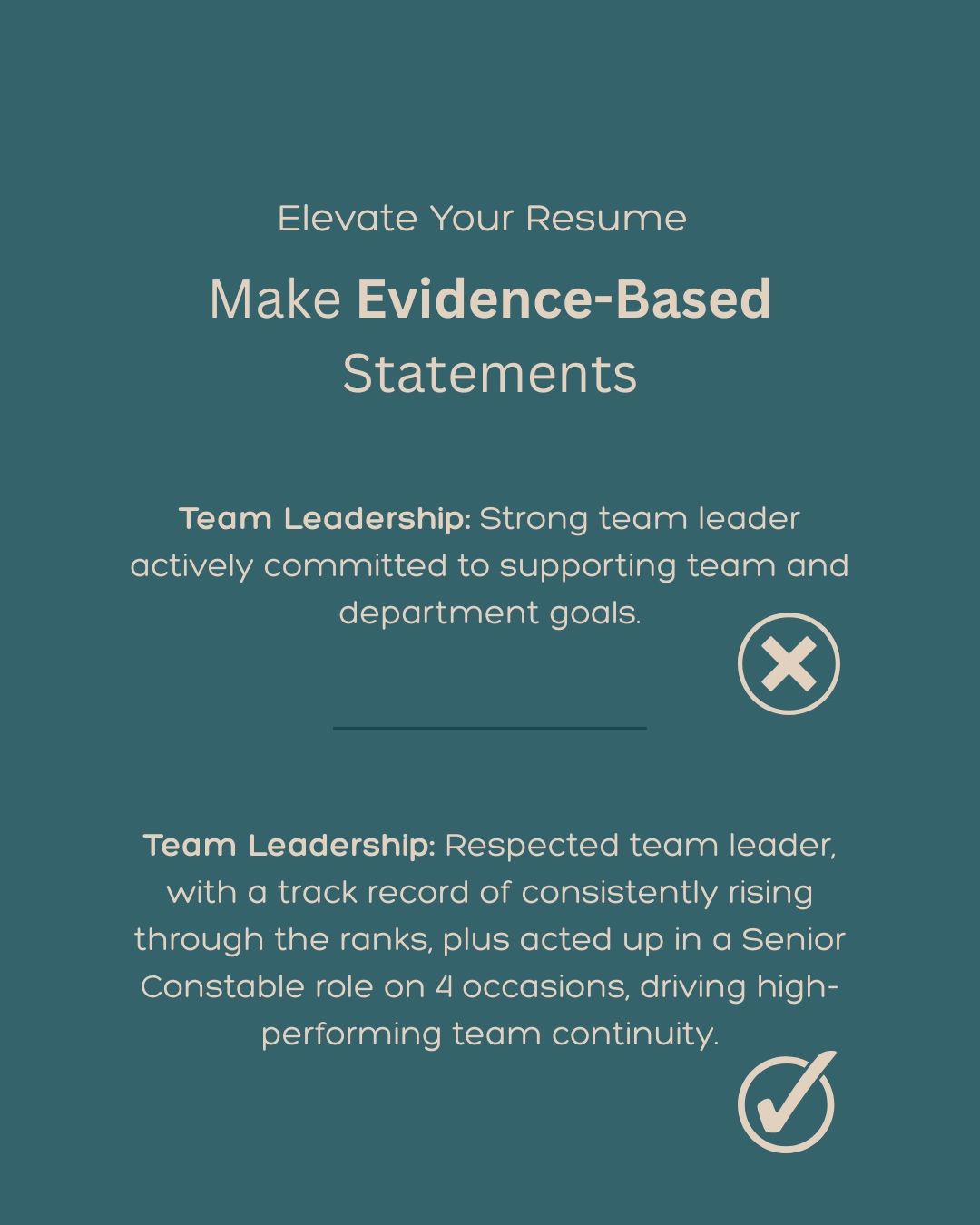
Writing sought-after skills lists into your resume isn’t enough. The recruitment process appreciates the power of evidence as much as you do. So, bring your law enforcement or first responder mindset to your resume writing. Make evidence-based claims and add proof points to your Key Expertise profiling, for example:
- Project Management: Led end-to-end planning and execution of major events, emergency management plans and crisis controls, ensuring strong risk management for high-profile and high-pressure community activities.
- Team Leadership: Respected team leader, with a track record of consistently rising through the ranks, plus acted up in a Senior Constable role on 4 occasions, driving high-performing team continuity
- Investigative Processes: Skilled in leading or supporting legal investigations, including evidence management, interviewing, reporting, writing and court appearances, ensuring the highest standards of legislative and regulatory compliance for community-centred outcomes.
Add further verifiable weight to these claims by enhancing the specificity based on your own experience. The key takeaway is that vague claims feel fluffy, while evidence adds proof.
Showcase and quantify your community impact in your resume
We appreciate that being a first responder isn’t all about knocking down doors to save lives, fighting fires or fighting crime. Contrary to what we might see on our TV, we understand it’s likely the less dramatic moments in your life as a first responder that could contain the clues to more of your transferable skills. In particular, first responders are naturally always of service to the community. From commercial entities or the public sector, most organisations value an ability to connect with the community directly on the front line. Reflect on how you can quantify or get specific about your community outreach skills or impact. For example:
- Delivered 12 presentations across high schools and primary schools annually, demonstrating strong verbal communication capabilities to audiences of 500+ people.
Your everyday activities or elements you assumed were unique to the world of first responders may well be in-demand skills across all industries.
Demonstrate your Recognised Prior Learning
Recognised Prior Learning (RPL) is a formal process that supports you to earn credit towards a qualification or course based on the skills and experience you have already gained. It’s a great way to recognise your existing competencies in a formalised way. If you have RPL or plan to pursue this, be sure to highlight this in your resume to further emphasise your transferable skills to an employer. Even if you haven’t received the outcome of your RPL application yet, list the qualifications you have applied for with a ‘Processing Pending’ or ‘In Progress’ note beside it.
2. Showcase your ‘STAR’ Potential for any Role: Writing Standout Highlights in Your Resume
We find that many police transition, ex-Defence, or first responder clients we work with, from police officers to firefighters and ambulance officers, find confidence in pivoting their professional experience into government, regulatory, legal or administrative roles. Leveraging your existing skills and understanding of the public sector can be a natural next step.
When applying for a new role in government, remember that the public sector relies heavily on selection criteria frameworks. Grounded in fairness across all candidates, these link core capabilities to the role and are designed to ensure the best person for the position can shine through the recruitment process.
If you’re applying for roles in the government, integrate the core capabilities and key selection criteria into your resume. For example, through your Key Expertise profile and role highlights.
The STAR formula is the government’s go-to for assessing selection criteria responses, pitches, statements of claims or cover letters. But, whether you’re preparing these documents or your resume, reflect on your career highlights is a great foundation for understanding your value and how to ‘pitch’ yourself. Using specific examples to show measurable impact, it breaks down:
S – Situation (Position the problem or context)
T – Task (Your role in addressing the problem)
A – Action (Outline the steps you took in your role to overcome the problem)
R – Results (The outcomes and what was achieved – think transformational states).
While the STAR formula works wonders for your brainstorming, government pitches and interview preparation. For a simpler alternative to your resume writing, consider these methods too:
- SAO – Situation, Action, Outcome
- CAR – Context, Action, Results
Tiny details matter when it comes to writing a resume that grabs a skimming recruiter or hiring manager’s attention. So, once you have your highlights mapped out, consider flipping key components. For example, move the outcome upfront to immediately engage your hiring manager with action-oriented impact.
Here are some examples of role highlights you can dot-point in the Professional Experience section of your resume:
- Managed daily operations for 5 police stations, including establishing the sector vision and fostering a high-performing culture to meet key deliverables across staffing, operational readiness, training, community and government partnerships.
- Coordinated a national response to the high-profile public transport crisis with multiple fatalities. Collaborated with industry authorities to resume operations during major closures, and liaised with state and federal ministers. Managed investigations, crime scene procedures and media activities.
For more on how to position yourself perfectly for your next role in the government sector, see our step-by-step guide on how to decode government selection criteria.
3. Think in Systems
It’s easy to get so focused on the front line that you lose sight of how your work, highlights and contributions in your career sit within a much bigger picture. The best resume writing demonstrates the systems at play within an organisation and how these interact with broader systems. So, when you’re preparing to write your resume, zoom out. Think in systems, such as:
- Key stakeholders
- Governing policies, acts/legislation and regulatory requirements
- Cross-departmental collaboration
- Inter-agency relationships
- Commercial partners
- Not-for-profit partners/programs
- Community groups
By highlighting your contributions to these systems, you demonstrate not only your transferable skills but also an understanding of how your role fits within a wider perspective. It also shows your commitment to supporting broader business goals. Both the private and public sectors love big picture systems-thinkers.
4. Reflect Before You Write Your Resume
Due to the challenges you likely faced on the front line or the systems you’ve served in, reflecting on life as a first responder can be a challenge. Before you stare at the blank page of your resume or log in to your consultation, leverage the resources available to you, reflect and prepare.
As an example, the NSW Police Force demonstrates its efforts to protect and serve its own, even in life beyond the police force. It has a range of useful resources available here. Plus, it’s More Than a Cop online program is designed to prepare you for civilian life.
The transition from police officer to civilian can be daunting. But the research indicates that this can be minimised by preparing for the change ahead of time and understanding the impact of the change as it occurs. Among other things, the program will support you in preparing for the career transition.
Be sure to leverage the relevant resources of your dedicated first responder field. There may be a variety of support services available to you to support you in navigating your career change.
Before rushing to immediately book your consultation, take the time to reflect on your highlights and transferable skills. You might discover some high-value resources available to you to support you through these self-reflection stages. As an example, the NSW Police Force helps you map:
Or,
Once you have aligned your experience to a public sector equivalent, you’re in a better position to target your documents to a relevant role.
Depending on whether you’re targeting the federal or state system, here are some links to help you learn more about what skills and capabilities the various grades are seeking:
Australian Public Service:
- APS – Cracking the Code
- APS – Integrated Leadership System (ILS)
- APS – Values & Code of Conduct in Practice
State and Territory Systems:
- NSW Capability Framework
- VPS Capability Framework
- ACTPS Capability Framework
- QPS Capability Framework
- WA Capability Framework
To ensure best outcomes for your job search process, whether you’re targeting the public or private sector, we require our clients to have a basic understanding of their target roles before proceeding to work together. When you’re ready, you can explore our resume, cover letter, LinkedIn profile or government application services here. If you want to get ahead of the resume writing process or learn more about what’s involved, you can also book a free discovery call directly with me.
5. Partner with a Resume Writer you can Trust to Do the Heavy-lifting
Your career transition is not the time for low-touch, impersonal and rapid resume writing service. Engage a high-touch resume writing service (hello, Elevate!) and partner with a writer you can trust.
We understand the transition from law enforcement, ambulance services or fire and rescue can be a more difficult one than most other career pivots within civil sectors. We are sensitive to the heavy mental burdens that a lot of first responders bring to the career transition process. The clients we work with have often experienced psychological or physical injury that were either the catalyst for the career change or challenges they have faced since.
After your time serving and protecting the community, rest assured that with our resume writers, you’re in safe hands to help navigate this next stage. We take care in matching your experience and personality to the best resume writer for you. Additionally, we also offer interview coaching services to prepare you to transform your skills on paper into high-converting real-world conversations. To start to put some faces to your resume writing process, get to know our team here.
While reflecting ahead of your consultation is helpful, your resume writer is skilled in transforming your seemingly everyday activities or easily overlooked highlights into resume gold. The real magic happens within your consultation itself – an essential part of our distinguished high-touch resume service. No matter how much you’ve prepared ahead of time, your resume writer knows all the right questions to ask to prompt the best highlights for a high-calibre resume.
Set yourself up for success in the next stage of your career
We know it’s not easy picturing a future beyond your life as a first responder. But, by empowering yourself with the best resume, you’ll open new doors and align your skills, experience and goals, to move toward the right role for you.
Contact us to start the conversation about writing your resume, cover letter, LinkedIn profile or government applications.


