

Wondering why you aren’t getting interviews? It could be that you’re overlooking common resume mistakes that raise concerns with recruiters.
Job searches can be a frustrating journey. If it’s not the roller coaster ride of preparing resumes and going to interviews, it’s that sinking feeling when you don’t even get a call to begin with. This is especially compounded when you’re confident you were the ideal candidate for the role, yet can’t comprehend why you weren’t shortlisted for the next stages of the recruitment process. It’s likely not your experience that’s the problem, but the red flags in your resume that a recruiter can’t see past. These common resume mistakes might not be all that obvious to you, but can be the quiet killers of your credibility.
From my insider knowledge of hiring managers and serving the resume-writing industry for over a decade, here’s what I know holds a resume back with recruiters:
Resume Red Flag #1: Poorly Communicated Job Hopping
Humans are hardwired to look for patterns. Add to that, recruiters naturally view your resume through a risk management lens. Is this person a performance risk? Is this person a cultural risk? But hiring managers aren’t just evaluating your resume for fit; they are assessing your resume for long-term reliability.
Job hopping isn’t automatically a bad thing. It’s inadvertently painting the picture that you jump from job to job for unexplained reasons that is the red flag. The recruiter is left wondering if you get bored quickly, if there was a performance concern or if there was another reason your tenure terminated somewhat abruptly.
But a few simple fixes for this resume red flag can show your long term value and performance strengths:
- Move roles to the Earlier Career section of your resume: This immediately shifts the weighting in your resume and keeps the focus on the most relevant roles.
- Explain shorter tenures: Mark all contract roles in your resume as such. For the positions you’re explaining in more detail, share reassuring details, e.g. Were you engaged for a special project? Were you headhunted for another role? Did a restructure cause your role to be made redundant?
- Sell your skills strongly in your most recent and relevant roles: Own your achievements and sell your skills confidently in the roles you are highlighting. It signals your commitment to a high-performance attitude, no matter how long you spent in a position.
Job hopping doesn’t stop hiring managers from calling; it’s the stories they create in their minds if you don’t address it that does.
Resume Red Flag #2: Unaccounted-for Career Breaks
What if you didn’t just job hop, but stopped working altogether? Career breaks also aren’t inherently the problem – it’s unexplained absences that are a common resume mistake. When writing a resume, we always advise our clients that best practice is to be transparent. Similar to job hopping, if you aren’t addressing a career gap, it raises a red flag for recruiters – one heightened by their own imagination.
Hiring managers understand that life happens; businesses pivot, or personal priorities might temporarily need redirecting. Taking breaks for caregiving, study, travel, wellbeing, redundancies or relocating are viewed reasonably by most recruiters. It’s silence that creates speculation.
Instead of writing a resume with glaring career breaks, control the narrative, addressing breaks in your:
- Professional Experience
- Career Snapshot
- Value Proposition
Don’t make the resume mistake of shying away from your career break. Own it with confidence, and you’ll reassure recruiters too.
Resume Red Flag #3: Inconsistencies Across Your Resume
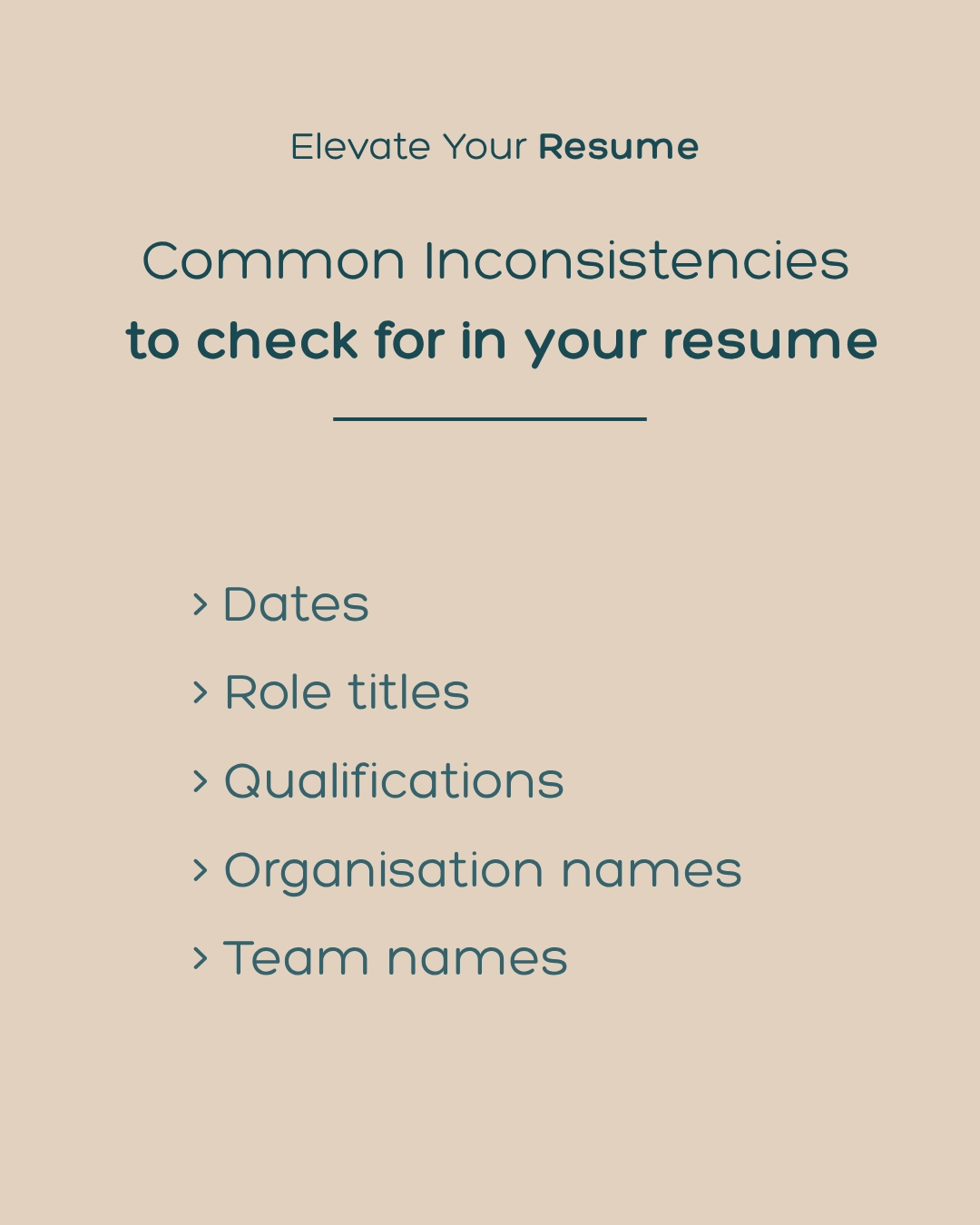
Remember, a risk management mindset puts recruiters on alert for seemingly small inconsistencies in your storytelling. Don’t make the resume mistake of misalignments across your:
- Dates
- Role titles
- Qualifications
- Organisation names
- Team names
Consistency in your overall career narrative is also important. For example, the headline you package your resume with or your Key Expertise skills profiling on Page 1 should align with the highlights you share in the roles.
But creating consistency in your resume doesn’t stop there.
As Robert Walters highlights in their article about how to build a strong personal brand, recruiters are now more likely to research potential job candidates’ online profiles before inviting them in for an interview. For example, they might Google you or check your LinkedIn and other social media profiles. Make sure your digital footprint is one you’re happy for potential future employers to see.
It’s not always character consistency that hiring managers are assessing across your resume and online presence either. When they land on your profile, ensure they don’t accidentally discover inconsistencies in your professional details. For example, be sure dates, titles and other key details in your resume are also aligned in your LinkedIn profile.
Conduct the same cross-check of your cover letter. Check that all references to numbers or titles align with the details in your resume.
P.S. At Elevate Career Services, we offer complete career branding packages. Explore our cover letter and LinkedIn services to present a fully integrated and consistent professional brand.
Resume Red Flag #4: Errors in Your Resume
Typos or spelling errors can quickly break the trust you’ve been building with recruiters. While most hiring managers understand that you are human, spelling mistakes cause recruiters to conclude that you didn’t care about the role enough to proofread and polish your final application, or that you lack attention to detail. Instead of saying that you’re detail-oriented, an error-free resume does this for you.
No matter how much time you’ve spent writing your resume, before submitting your application, assume that your resume likely contains errors you initially overlooked. Your brain has a natural autocorrect effect. It predicts meanings and mentally adjusts typos to what it expects you meant to say. This is compounded by a familiarity blindness – when you’re too close to your own writing and know what you intended. What others might spot instantly, you may have skipped over several times.
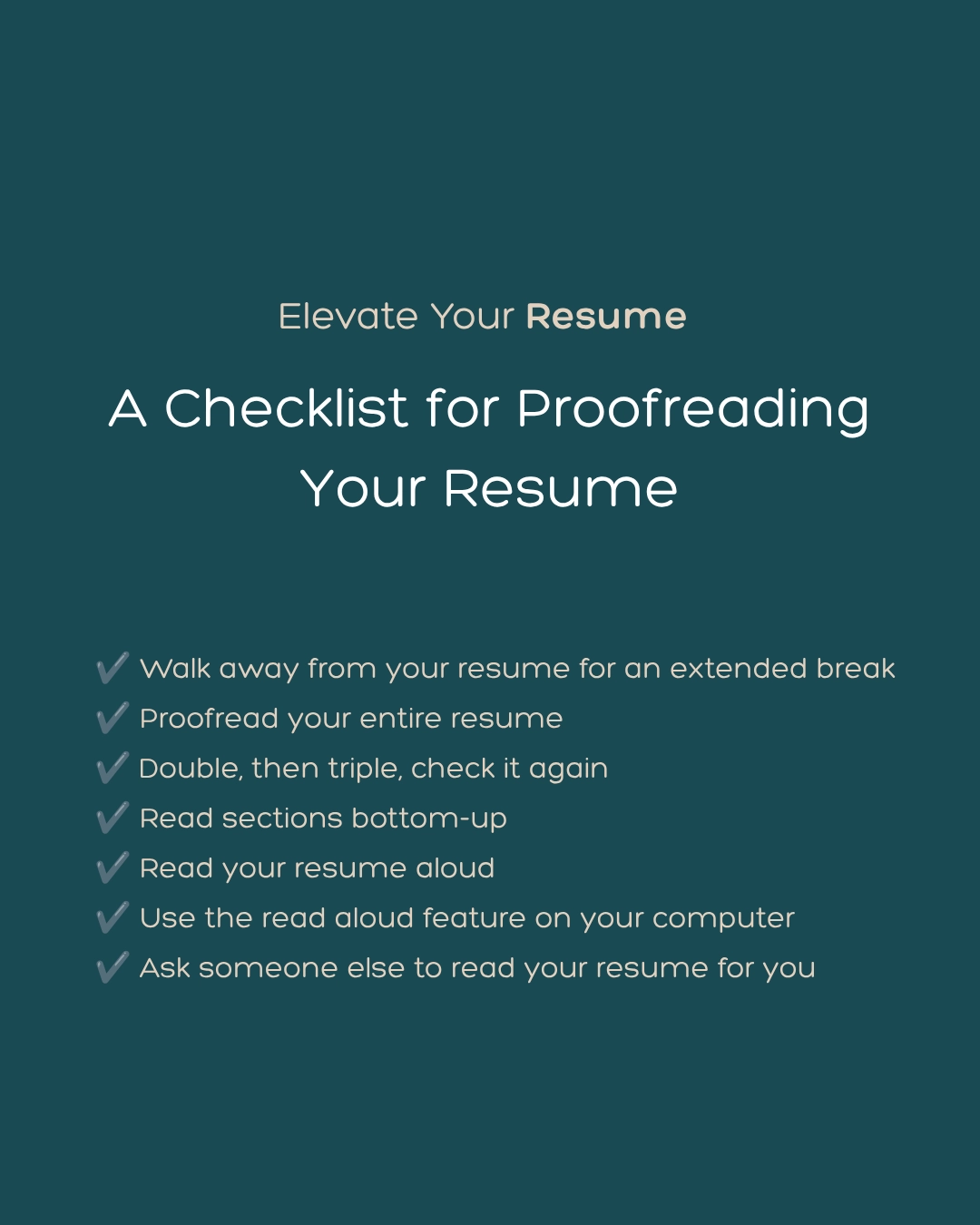
To give yourself the best chance of avoiding any embarrassing errors, don’t skip any of these steps:
- Walk away from your resume for an extended break
- Proofread your entire resume
- Double, then triple, check it again
- Read sections bottom-up
- Read your resume aloud
- Use the read-aloud feature on your computer
- Ask someone else to read your resume for you
Disrupt the pattern; see your resume with fresh eyes and spot easily overlooked mistakes.
Resume Red Flag #5: Robotically Written Resumes
The proliferation of AI-written resumes has increasingly become a headache for hiring managers. A perfectly polished resume might sound professionally impressive to you, but for a recruiter’s trained eye – one that likely reads resumes all day – it’s easily identifiable language patterns, lacks personalisation, impact and emotional intelligence. Don’t make the mistake of believing your AI-generated buzzwords, perfect grammar and seamless sentence structures are communicating anything of real value – many AI-written resumes aren’t.
At Elevate Career Services, we understand that it’s the nuances of each role, each achievement, that spin your resume into career branding gold. We get to that gold through your consultation, included in all our resume packages. Whether you decide to engage our services or not, remember it’s the details that separate your resume from the rest. If your resume reads robotically or like generic responsibilities listed in a job description, it will sound like anyone else can do the job as well as you. AI-written resumes might feel like a quick or free win for your job search, but they can cost you opportunities in the long-run.
Personalise your resume across all key sections, and it will read like only you could have had the impact you did. For example:
- Use first-person references in key sections, including your Value Proposition and role blurbs
- Create a categorised skills profile with references unique to your career profile
- Swap responsibility lists for Achievements or Highlights
Your skills and diligence in customising your career branding will stand out in a sea of sameness to recruiters.
Resume Red Flag #6: Lack of Proof Points in Your Resume
Inflated claims can put hiring managers on high alert. They expect bold statements to be backed up by evidence. They understand that your resume, at this stage, hasn’t been independently verified, so they look for signals that your initial claims seem credible. The common mistake of unsupported assertions causes your resume to sound like hyperbole.
Substantiate your claims with specific details or data points such as:
- Sales
- Budgets
- Project values
- Cost savings
- Time saved
- Growth
- Reach
- Conversion rates
- Team sizes
- Turnaround times
Proof points in your resume show the measurable impact you’ve had in your roles.
Resume Red Flag #7: Lack of Ownership
Impact begins with ownership. Passive language in your resume can make you sound uncertain or unclear about your value and contributions to a position.
Active language, however, sounds direct and confident. The way to overcome the common mistake of passive language is by adding active verbs – action or doing words – to your resume. For example:
- Drove
- Project-managed
- Led
- Initiated
- Redesigned
When it comes to resume writing, not all verbs are revered equally. Weak verbs can signal a lack of ownership and decision-making leadership. For example, overusing words like:
- Supported
- Assisted
- Contributed to
Leadership traits and high-performance confidence are in demand at all levels. This isn’t about taking credit for everything or acting as if you operated alone, but confidently owning your role in a bigger story.
Resume Red Flag #8: Lack of Context for Role Achievements
Bold confidence is only a problem when it lacks context. Data points, as we already discussed, add evidence to your claim, but numbers alone don’t speak for themselves. Recruiters don’t have a crystal ball into your career. Outcomes alone don’t sell your value. How you achieved them and why it mattered does.
Consider the CAR method for your resume highlights:
- Context
- Action
- Results
The CAR method allows you to demonstrate:
- How you worked with others
- Why what you did mattered
- Key capabilities in your process, aligned with those valued in the target role
- The ‘before’ and ‘after’ state
Pro Tip: For extra impact, in some instances flip your statement so the outcome is emphasised at the start of your highlight.
Context is the mini storytelling moment of your resume. Don’t make the mistake of inadvertently poking holes in your narrative.
Resume Red Flag #9: Unclear Career Branding
Sometimes it isn’t that your resume lacks a career narrative – but it lacks one with any cohesion. Again, we are hardwired to look for patterns; in a resume, you want claims to be reinforced. This doesn’t mean excessively repeating ideas but rather, ensuring that there are narrative threads that weave the unique value proposition of your resume together. For example, if you claim to prioritise process improvement, but your resume shows no highlights related to that, you aren’t backing up your story or clearly defining your career branding.
Show patterns of your strengths across roles, and your recruiter will see your value more clearly. For example, are you best known for:
- Continuous improvement initiatives
- Leveraging insights to drive data-driven decision-making
- Reorganising and redirecting resourcing for immediate impact in a role
Then share highlights that reflect these strengths.
Don’t make the common resume mistake of starting career stories that go nowhere or leave hiring managers to connect the dots. Brand yourself clearly across your resume.
Resume Red Flag #10: Poor Formatting
Eye tracking studies have shown that, on average, recruiters spend approximately 7 seconds on the initial scan of your resume, before deciding if a candidate is worth another 2-5 minutes of their time. Formatting plays a big role in this initial evaluation. It is the shop front window of your professional brand. It leaves an immediate first impression on recruiters before you’ve even said a word. Like glancing into a shop window, recruiters are deciding if they want to step inside and explore more or move right along to the next resume.
Don’t make the mistake of having notably poor formatting. Even if you’re the ideal candidate for a role, it can put you on the back foot for an interview upfront. This includes:
- Causing the reader to have to dig for key details they’re scanning for
- Unprofessional or distracting fonts
- Over-use of colour or other imagery
- Illegible font sizes
Other formatting elements are a little more nuanced, but can either ease the burden on or overwhelm a recruiter. For example:
- Use of spacing
- Bolding
- Use of italics
- Lines per section
Now, with the increasing use of Applicant Tracking Systems (ATS), some design choices can immediately scramble how your resume is read by ATS. Common issues can come from ATS-unfriendly:
- Font choices
- Use of images
- Multi-column designs
Our resume templates are formatted with ATS in mind, while we write for a human reader.
Resume Red Flag #11: Inadvertently Creating Biases
Canva-designed templates, on face value, can appear a little more exciting than traditional templates, but be wary of over personalising your professional personal brand. As shared in Forbes, oversharing can be a red flag for hiring managers. Your resume should focus on details relating to your ability to perform the job. Avoid the mistake of sharing:
- Photos
- Personal social media handles
- Marital status
- Date of Birth
- Religious or political affiliations
While the above might feel like it personalises your resume and communicates your values, for most industries, unless it’s of importance to the role, they are irrelevant. In some cases, like including your photo or identifiable affiliations, it can create subconscious biases within a recruiter who was otherwise actively avoiding any preconceived notions of you.
A well-written resume will sell your value, and share what you need it to – no more.
Get the Green-Light from Recruiters
The difference between being overlooked or called into interviews isn’t always your experience, but how that experience is communicated. Don’t let easily overlooked resume red flags distract from your value and deter recruiters. When you understand common resume mistakes and the reassurance hiring managers seek, a strategically written resume can transform your job search from crickets to calls for interviews. If you need help writing a green-light resume, our team are ready to assist. To learn more about our resume packages, contact us.


