

In Australia’s highly competitive government job market, writing exceptional STAR examples is the key to progressing in government recruitment processes. We’re sharing how to highlight your star potential to recruiters.
If you’re finding yourself being overlooked for government jobs, the problem likely isn’t that you lack the transferable experience and skills for your next role, but how you’re communicating it. To shine in a sea of other applicants vying for a coveted role in government, let’s deep dive into how to write standout STAR examples. With over 10+ years of experience professionally writing government applications and addressing key selection criteria, I’m sharing what I’ve learned to help get you shortlisted for the next ideal role.
1. What is a ‘STAR’ Example?
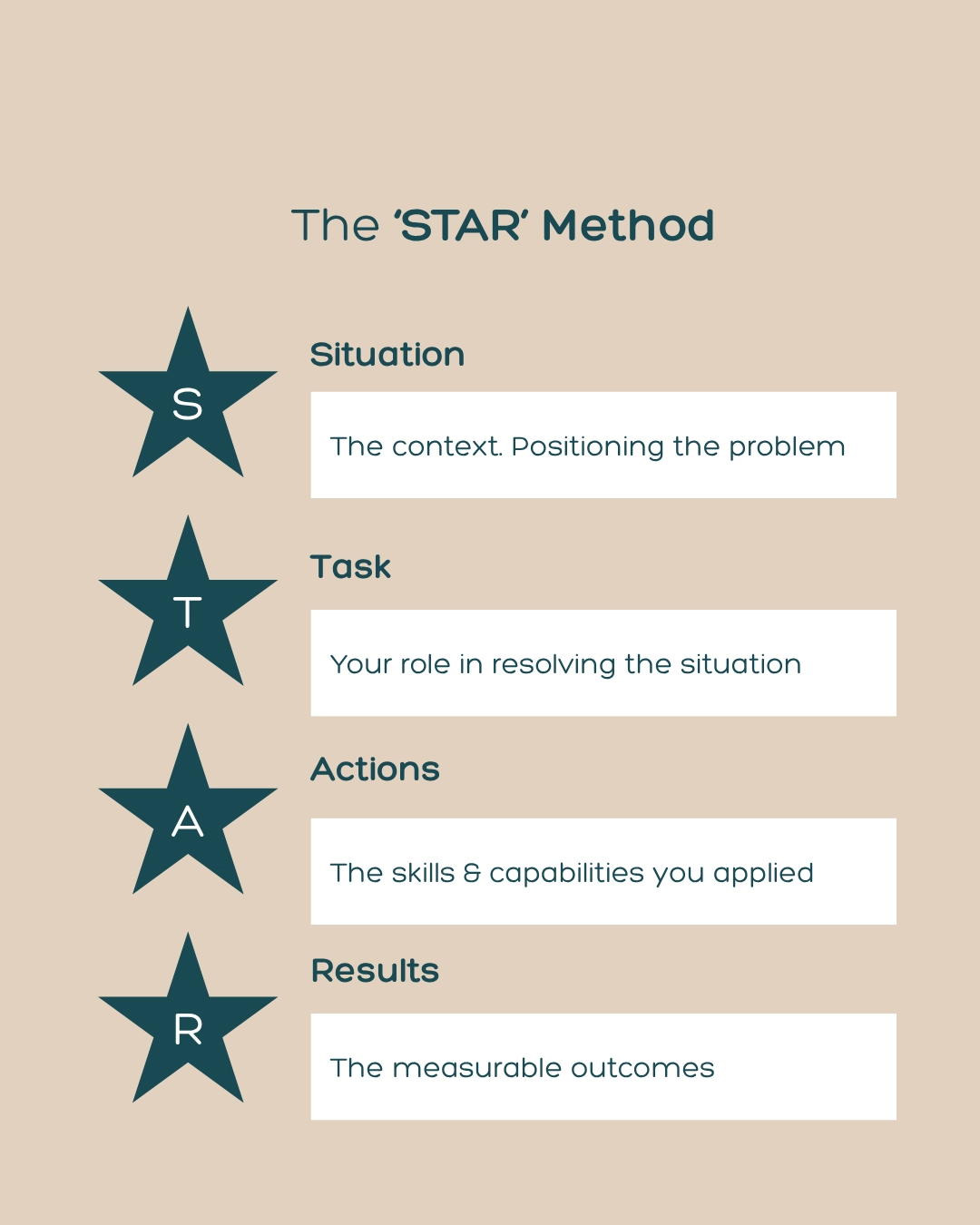
Simply put, STAR examples encompass:
- Situation: What was the context or problem?
- Task: What was your role or responsibility?
- Action: What steps did you take?
- Result: What was the outcome?
Whether it has been explicitly stated or not, there is an expectation across all government applications that you are highlighting STAR examples.
A well-written resume will provide examples within each role’s Highlights or Achievements. However, for the purpose of government recruitment processes, more weight is placed on STAR examples in the requested supporting documentation. For example, in the:
- Pitch
- Statement of claims
- Cover letter
- Responses to selection criteria, or
- Responses to key questions
Always assume STAR examples are critical to your application – not an afterthought.
2. Why are STAR Examples so Important in Government Applications?
If you’re new to the world of STAR examples, the formula has been a rising trend in recruitment for several decades now. As a behavioural interviewing framework, it helped hiring managers elevate traditional interviews from inconsistent and subjective conversations to evidence-based insights into potential candidates. By swapping hypothetical scenarios and vague statements for real-world examples, STAR standardises the recruitment process across all candidates. Making STAR a priority, from application to interview stages, it has since become common practice across the public and private sectors.
Securing a role in government, at a local council, state or federal level, is most often a highly competitive process. The public sector, combined across Australia, is the largest employer in the country. It offers attractive opportunities for career stability, flexibility, career progression and the chance to contribute to high-impact initiatives. With these perks comes an often much more rigorous recruitment process.
In government, it’s not about who you know, but what you know, what you can do and how you operate. It is a merit-based system and takes its responsibility for equity very seriously. While public service recruitment processes can seem more demanding in comparison to other non-government applications, they ensure the best person for the job gets the job. Now, let’s make sure your application positions you as that star candidate!
3. First, Decode the Government Job Advertisement
Unlike their private sector counterparts, government roles require you to do a bit more digging upfront to understand what the application is asking of you.
For example, look for sections like:
- Essential Selection Criteria/Desirable Criteria
Sometimes this might instead be called:
- About You
- What We’re Looking For
- Our Ideal Candidate
- What You’ll Bring to the Role
To properly assess the requirements of a role, I suggest you:
- Copy and paste the job advertisement into a new document
- Highlight all key areas, including role priorities, purpose, language and values
- Note the multiple parts of key points
- Download any available job candidate packs or position descriptions and do the same
Evaluating these documents before you start writing any STAR examples is essential to setting your application up for success. Note, not all government applications will ask you to write in a question-response format. Most government recruitment processes have moved away from this formula. Instead, a pitch, cover letter or statement of claims will likely require you to make some judgement calls about how you plan your writing.
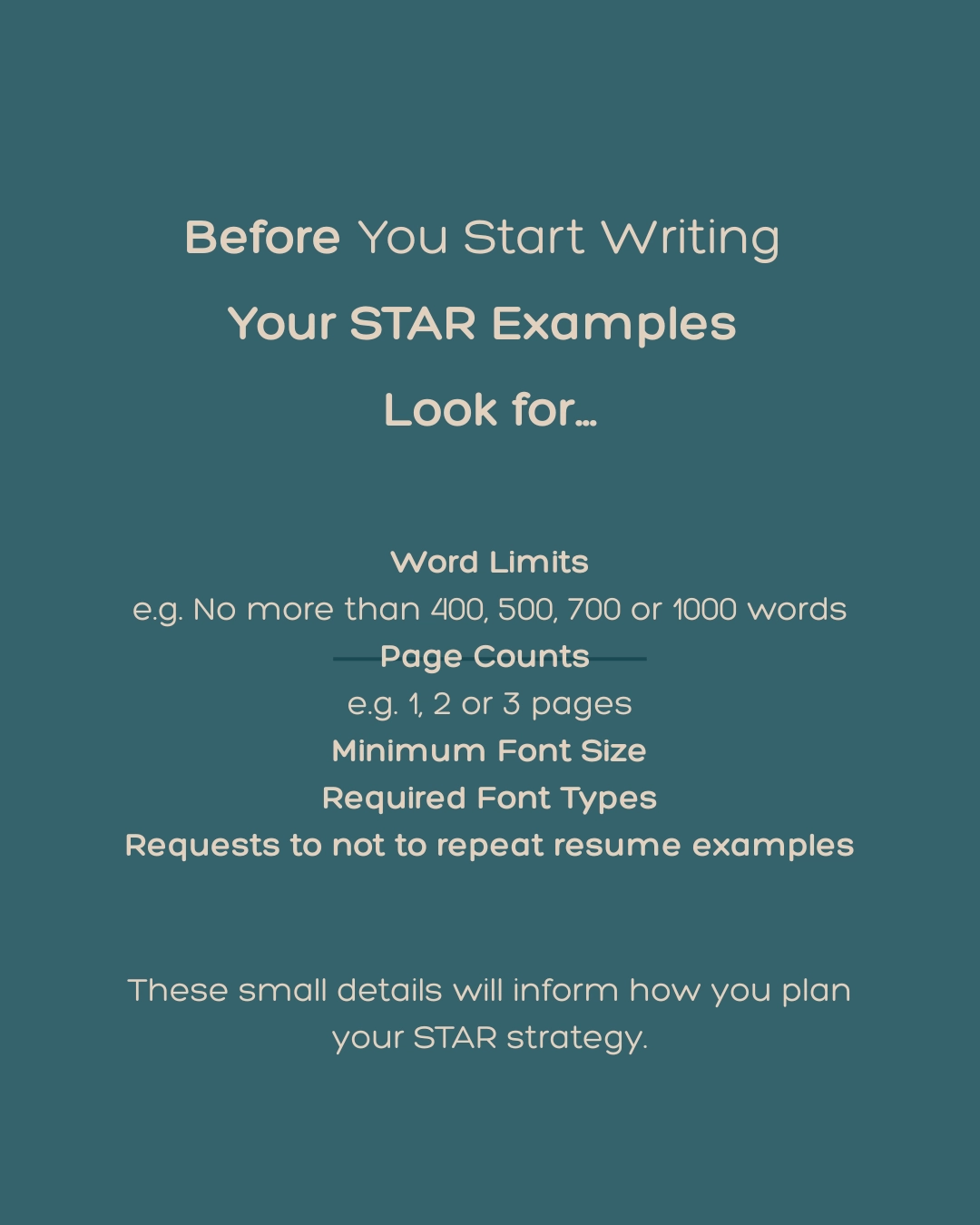
Ensure you understand the mandatory guidelines that the job you are targeting is requesting. For example:
- Word limits e.g. No more than 400, 500, 700 or 1000 words
- Page counts e.g. 1, 2 or 3 pages
- Minimum font size
- Explicitly requested font type
- Requests not to repeat examples from your resume
Some government jobs may have one of these requirements or a combination. In some, less common cases, none at all – calling for you to use your judgement for what’s reasonable to cover the requirements. In all instances, the key is clear and consistent writing that boosts your role alignment and credibility.
For more on how to make sense of advertised government roles, see my earlier blog How to Decode Selection Criteria: A Step-by-Step Guide for Australian Job Seekers.
4. How to Choose Your STAR Examples Strategically
The guidelines stipulated for the government application will help inform some of your STAR strategy. For example, in a 500-700 word or 1-page pitch, you’ll likely have to group key requirements together to form 1-2 more solid STAR examples.
To do this, consider:
- What is the selection criteria or application questions really asking you? g. Demonstrated understanding speaks to knowledge, while demonstrated experience prioritises skills in action.
- Where is there natural alignment?g. process improvement, leveraging data, stakeholder engagement and verbal and written communication skills might group well in an example.
- What example/s cover most or all of the selection criteria? e. What is most relevant to the role?
Remember, your greatest achievements aren’t always your sharpest STAR examples. The selection panel are evaluating you on the key selection criteria. Make sure your STAR examples are less about your favourite highlights and are instead firmly aligned to the position you’re targeting. But, if you’re new to government applications, here’s the twist you might not be as familiar with: You aren’t just aligning to the selection criteria.
5. How to Write Strong ‘Actions’ Sections in STAR Examples
Not all sides of your STAR examples are weighted equally. While following the formula is important, it’s the Actions and Results that should take centre stage in your STAR storytelling. This is because, alongside the selection criteria, you are also being evaluated on your alignment with key capability frameworks. Which is often not explicitly outlined in the advertisement or the Job Candidate Pack.
In most cases, for government roles, you will be provided with a level for the position. For example, in the Australian Federal Government, this might be:
- ASP 1-6 (Australian Public Service)
- EL1/EL2 (Executive Level)
A side note for executives: Even the best executives can struggle on the other side of the recruitment process. For more on how to write a standout resume, see our earlier blog How to Write an Executive Resume: Elevate Your C-Suite Positioning & Leadership Brand.
Here are some more important links if you are targeting an Australian Federal Government (APS) role:
Australian Public Service (APS):
- APS – Cracking the Code
- APS – Integrated Leadership System (ILS)
- APS – Values & Code of Conduct in Practice
State governments have their own individual systems and capability frameworks:
- NSW Capability Framework
- VPS Capability Framework
- ACTPS Capability Framework
- QPS Capability Framework
- WA Capability Framework
Whatever role you are applying for, the key is understanding what is expected in the capabilities of the ideal candidate and writing these into your STAR example. While this might be relevant across the entire STAR, it’s likely going to be most applicable in your Actions, as they are directly aligned with your skills. Equally, the Results you highlight in your STAR example should show that those Actions had an impact.
Let’s suppose, for example, you have found an APS5 HR Advisor – WHS role you would like to target. The APS – Integrated Leadership System (ILS) and the Guide to the Integrated Leadership System for APS 1-6 employees (downloadable as an ILS APS Guide) tell us more about the expectations and capabilities of all levels. Consult the guides for ASP5 details while you craft your STAR example.
Here is a STAR example that links to key APS5 capabilities.
When I first commenced in my role as WHS Officer for Johnson Construction, I identified a lack of formalised safety policies, protecting the wellbeing of the 100+ staff. Consulting with my Human Resources Manager, I discussed the process improvement opportunity and proposed that I take personal responsibility for the complex policy development project. This would align with the company’s shared vision to reduce high-risk incidents through a proactive safety-first culture.
(Here we have covered the Situation and Task)
After reviewing the existing policies, I thought strategically about the broader influences that impact teams’ work objectives. To gather feedback, I engaged in significant cross-functional consultation with 25+ key stakeholders. This included team leaders and frontline staff, valuing specialist expertise and capitalising on the skills of others. Through active listening, exploring diverse views and applying sound judgement, these helped us to collectively identify problems and plan improved work practices. With strong written communication skills, I then drafted the suite of policies, translating complex ideas with clarity and unambiguous language.
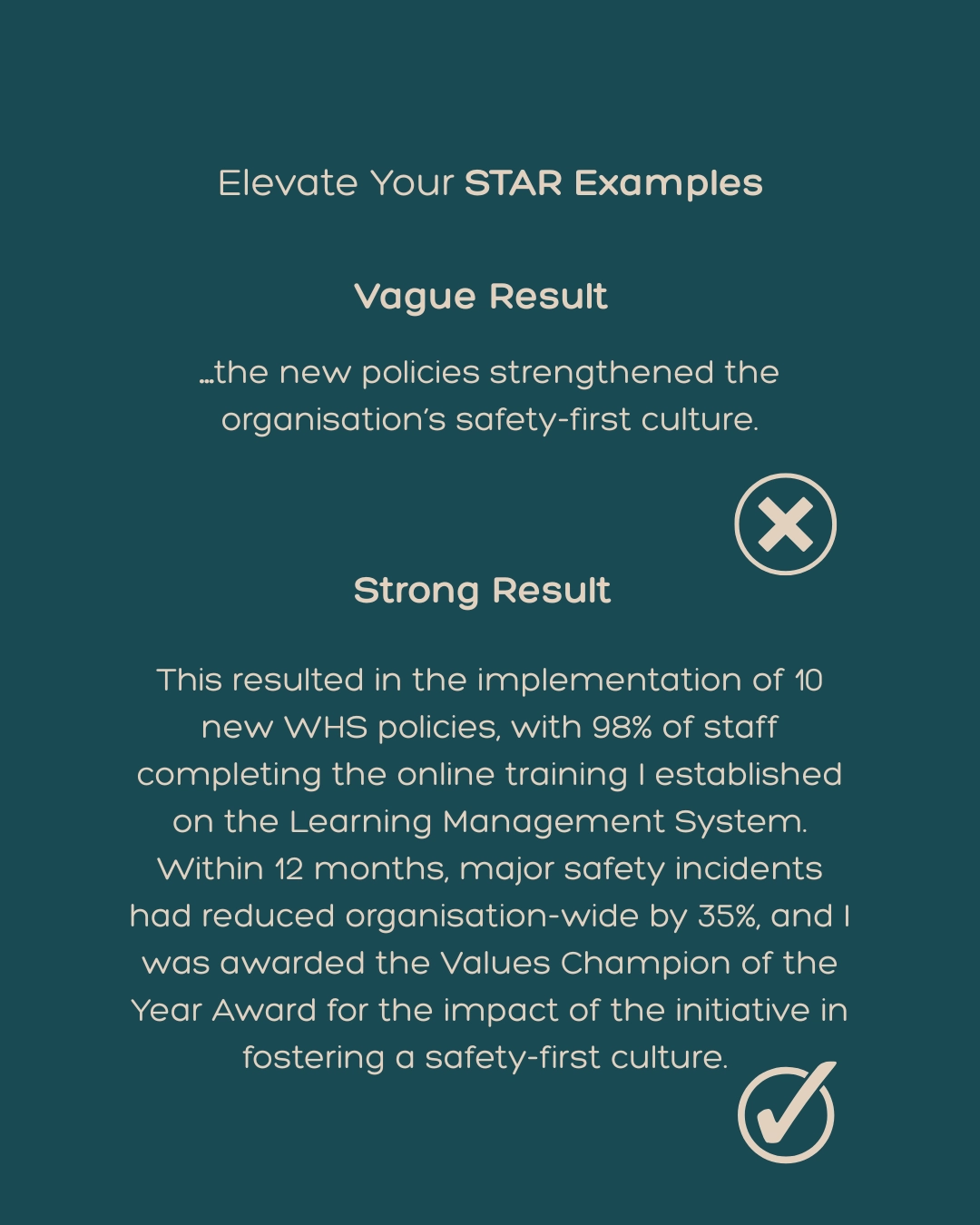
With the draft policies prepared, I identified that the most appropriate medium to communicate these was through 5 organisational-wide forums with up to 20 people per session. I communicated with influence, negotiating on key points and adjusted the policies in response to differing views and expertise. This resulted in the implementation of 10 new WHS policies, with 98% of staff completing the online training I established on the Learning Management System. Within 12 months, major safety incidents had reduced organisation-wide by 35%, and I was awarded the Values Champion of the Year Award for the impact of the initiative in fostering a safety-first culture.
(The above communicates the Actions and Results)
As you’ll notice from the above example, while you may think the skills and actions are implied, stating them explicitly helps them stand out to a skimming hiring manager comparing you to capabilities frameworks. E.g.
“I consulted with key stakeholders to gather feedback.”
Instead becomes…
“I engaged in significant cross-functional consultation with 25+ key stakeholders. This included team leaders and frontline staff, valuing specialist expertise and capitalising on the knowledge and skills of others within the organisation.”
Ideas for an Action-Oriented STAR Examples
The most relevant actions you took will vary depending on the situation you choose and your role level. However, here are some thought starters to prompt you for an action-minded STAR example:
Who did you collaborate with across departments or external organisations?
- Cross-departmental teams
- Other government agencies
- Third-party providers
- Key industry bodies, associations or stakeholders
How did you engage with key stakeholders?
- Hosting workshops/forums
- Facilitating surveys
- Engaging in one-to-one consultations/meetings or team meetings
How did you engage with management/executive leadership?
- Presenting to management
- Consulting one-to-one with regular updates
- Developing a report
- Escalating a matter as required, while also working independently
- Advising leadership on key recommendations or policy considerations
- Developing leadership briefings
How did you demonstrate your strong written and verbal communication skills?
- Writing a report
- Authoring a policy recommendation
- Presenting key findings or process improvement recommendations
- Facilitating training forums or workshops
- Communicating with management or key stakeholders
How did you align with policies and regulations?
- State specific Acts/legislation
- Show compliance with regulatory bodies
How did you engage with established systems and resources?
- Engaging with software systems
- Leveraging data-driven insights
- Following key procedures
- Accessing resources, reporting or other documentation
6. How to Quantify Results in STAR Examples
Numbers pop on the page of your application and add proof points to your claims. Numbers can be relevant across the entire STAR formula. For example, consider quantifying:
- Program participants
- Percentage growth
- Revenue growth
- Budget
- Team members/direct reports
- Cost savings gained
- People presented to
- People impacted/reached
- Workshops/forums delivered
- Consultations conducted
- Policies written
- Customers engaged with daily on average
- Project Timelines
- Efficiencies Gained
If you aren’t including numbers, still be as specific as possible. What value did your contribution have? What was the impact? Beyond vague statements about your capabilities and motivation, well-rounded STAR examples speak volumes for the skills you’ll bring to the role.
7. Editing for Clarity, Consistency & Credibility
With so much creativity flowing for your STAR responses, you need to carefully edit your pitch, cover letter or statement of claims.
- Ask yourself, can I say the same thing in fewer words? Make every word earn its place in your application.
- If you have the option to upload a document, use tactful bolding throughout.
- Check for any inconsistencies with references made in your resume.
- While pitches, cover letters and statements of claims are critical to government applications, resumes are still important. If you also need help with writing a standout government resume, learn more about our resume writing services.
From Overwhelming to Confident Government Applications
Don’t let the pressure of government applications prevent you from applying or putting your best foot forward for your public service position. Once you understand what makes a standout government application, you’re one step closer to securing the role you’re targeting.
If writing clearly and compellingly isn’t your forte, let our team help. We have written hundreds of government applications that regularly land clients interviews.
To learn more about selection criteria and pitch services, plus resume, LinkedIn and interview coaching, packages, contact us.


