

With 10+ years of expertise as an executive resume writer in Australia, I’m sharing the secrets of exceptional C-suite branding.
In today’s competitive executive market, a standout C-suite resume is no longer a simple career summary. It’s a strategic pitch for your personal brand. Writing an executive resume is more than listing your achievements; it showcases your brand of leadership, measurable impact and positions you as a future-focused leader ready to usher a business into a new era.
This blog is my guide for how to write an executive resume that positions you as a high-calibre, credible and sought-after leader – one that skilfully distinguishes you from a sea of other C-suiters.
1. Engage Storytelling Finesse to Write Your Executive Resume
Establish a connected narrative through your resume
The more comprehensive your career, the more important the art of strategic storytelling becomes. When writing your executive resume, remember, no one understands the relevance of your experience quite like you do. A recruiter skim-reading your resume has limited time to make sense of your experience. It’s essential that you quickly connect the dots for them. Here’s how to build a connected narrative in your executive resume:
- Value Proposition (Page 1): This is the elevator pitch of your resume. Integrate the most relevant roles, capabilities and industry experience as they relate to your target role.
- Career Overview Snapshot (Page 1): Spotlight only the roles that strengthen your relevant executive positioning.
- Select Achievements (Page 1): Highlight key words relating to relevant roles, industries and impact.
- Key Expertise (Page 1): Write your executive expertise profile with specificity. Aggregate key capabilities across your career, such as the range of team sizes and financial accountabilities.
- Role Blurbs: Leverage the introductions that open each key role to paint a picture of the scope of your leadership, governance structure and purpose of the roles.
Build your brand of leadership
Your executive resume isn’t just about what you’ve done; it’s about how and why you did it. When evaluating candidates with comparable capabilities and achievements on paper, the competitive advantage of executive leadership can come down to character. Your leadership impact is not merely about the strategic expertise you bring to the role, but your brand of leadership.
While remaining succinct, your executive resume should also reflect your:
- Values
- Your style of leadership
- Leadership philosophies
- Your priorities in the first 90 days or Year 1
2. Show Evidence-based Executive Impact in Your Resume
Your executive resume must credibly position your transformative leadership
Future-focused leadership is not about ticking boxes; it’s about transformation. Standout C-suite leaders unlock an organisation’s and team’s true potential. High-calibre executive leaders don’t settle for the status quo – they challenge it. They redefine what success looks like and pioneer new ways of working. But, this isn’t about making hyperbolic claims or fluffy statements. Vague claims in your executive resume hurt your C-suite credibility. Talented executives are masters of leading measurable impact and your resume must reinforce this.
To write an impactful executive resume, think in transformative states. For example, explore your highlights in more detail by leveraging the STAR formula to emphasise your positioning as a stellar problem solver:
- Situation: What was the context? Position the magnitude of the problem state.
- Task: What was your mandate or the initiative taken?
- Actions: What skills and capabilities did you apply in your leadership?
- Results: What was the outcome?
For a simpler alternative, try the SAO formula:
- Situation
- Action
- Outcome
Or, the CAR method:
- Context
- Action
- Result
To add further impact with action-oriented openings, flip the components of your dot points to highlight the outcome upfront.
Note, most government roles, including at an executive level, require you to engage the STAR formula in your application. To position yourself strongly for executive-level public sector positions, see my step-by-step guide on how to decode government selection criteria.
Write your executive resume with data-driven proof points
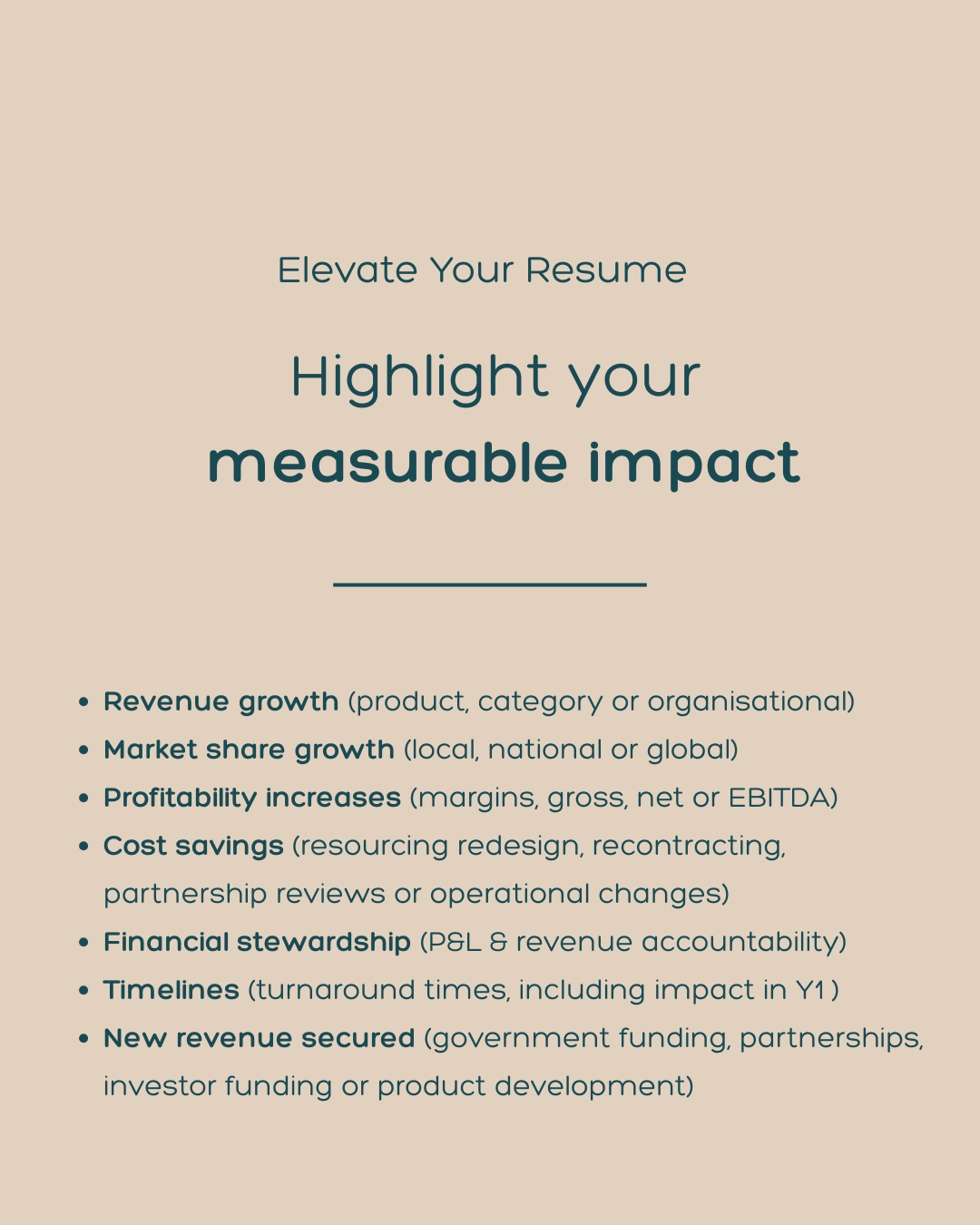
Numbers add data-led credibility to a C-suite resume. They emphasise the measurable impact of your leadership capabilities. The most relevant numbers for an executive resume will depend on your field of leadership and industry, however, here are some thought starters:
- Revenue growth (product, category, department or overall)
- Market share growth (local, national or global)
- Profitability increases (margin, gross, net or EBITDA)
- Cost savings (resourcing redesign, recontracting, partnership reviews or operational changes)
- Financial stewardship (profit and loss accountability, revenue responsibilities and expenses)
- Timelines (turnaround times – including impact in Year 1 and other early years or months)
- New revenue secured (successful government lobbying and funding secured, new partnerships, investor funding or new product/category value)
3. Sell Your Technical & People Leadership in Your Resume
Showcase specialised knowledge & transferable skills
If you’re looking to advance within your industry, show the recruiter you understand the nuance of your sector like no other. This isn’t about overwhelming the reader with industry jargon, but rather clearly positioning your specialised industry knowledge as your advantage over executives looking to change industries.
If you are, however, an executive looking to change industries, highlighting your transferable skills is essential. You must show your leadership has influence, no matter what the role. Whether you’re changing lanes or not, here are some broadly sought-after skills for top-performing executives.
- Organisational & Strategy Leadership – Long- and short-term strategic plans, master plans and business plans.
- Commercial Astuteness – Scope of financial leadership.
- People Leadership – Direct reports, varying team sizes and dispersed geographic locations (both remote and in-person).
- Risk Management – Change management strategies and legislative or regulatory compliance.
- Governance – Experience in highly accountable and complex governance structures, e.g. publicly listed companies, shareholder accountability, board accountability, private equity structures, government agencies, member-based organisations.
- Stakeholder Engagement – Commercial partners, industry bodies, private business and government relations.
- Technology Transformation – Digital transformation, IT infrastructure or other onsite assets.
While these are generic examples, articulate your skills to them uniquely your own, ensuring you add specificity to your own executive resume.
Demonstrate AI leadership
AI leadership deserves a special call-out here. With AI evolving at a rapid speed, AI is a priority across recruitment, industries and in organisations. According to Forbes breakdown of trends that matter most, AI fluency is not optional and is an expectation, no matter what the role or level. According to the CEO of LinkedIn, AI job postings requiring AI literacy have risen by 70% from just one year ago. Companies understand that AI will now make or break a business. A McKinsey research report showed that companies with AI capabilities outperform competitors by 2-4 times in total shareholder returns.
These trends are actively reflected in the Australian job market. For example, LinkedIn also revealed the fastest-growing jobs in Australia, with AI a standout skill. AI literacy is also now the most in-demand skill Australian employees seek across all jobs on LinkedIn, with 8-10 global leaders more likely to hire someone skilled in AI tools than someone with more experience but less AI proficiency.
AI is not reserved for your operational teams. As corporate strategy shifts from adoption to transformation, top executives must be seen to be leading from the front, embedding AI into core business operations.
4. Think Systems & Stakeholders
Influencing internal systems & industry at large
High-performing executives don’t operate in a bubble. They think in systems. They understand complex systems at play internally and externally, plus how these systems interact with each other.
Your executive resume should showcase your ability to optimise across micro and macro environments.
Micro factors that affect the business directly include:
- Employees
- Customers
- Competitors
- Suppliers
- Distribution partners
- Shareholders
- Members
- Boards
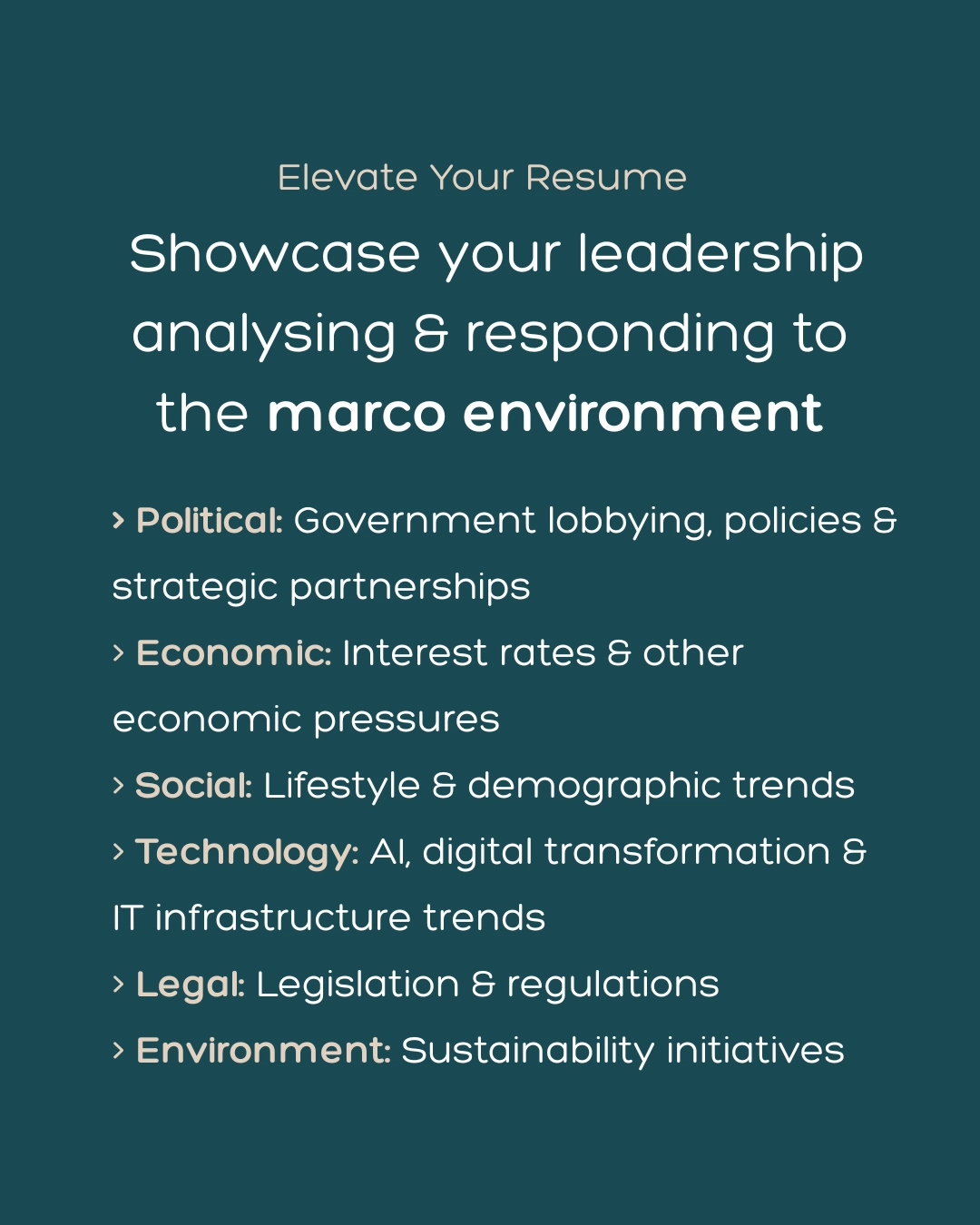
Demonstrating your ability to analyse and respond to the macro environment highlights your talent for leading and influencing your industry. Leveraging PESTLE, is a good guide for highlighting your skills across key landscapes:
- Political: Government lobbying, policies and strategic partnerships
- Economic: Interest rates and other economic pressures
- Social: Lifestyle and demographic trends
- Technology: AI, digital transformation and IT infrastructure trends
- Legal: Legislation and regulations
- Environment: Sustainability initiatives
Don’t simply position yourself as an effective organisational leader in your executive resume. For more memorable executive impact, position yourself as an influential industry leader skilled in responding to broader market trends.
Community impact
Executives are masters at leveraging their high performance for community impact. To elevate your contributions to your industry further, add community impact in your executive resume and highlight:
- Board & committee memberships
- Association affiliations
- Mentoring
- Publications
- Key speaking engagements
Outside of your everyday, these enhance the character and credibility of your executive resume.
Bonus tip for your LinkedIn profile: Most recruiters are also checking your LinkedIn profile – the perfect place to add more character to your leadership positioning. If your LinkedIn profile isn’t selling your personality and unique value proposition, learn more about our LinkedIn profile writing services here.
5. Edit your resume like an Executive
The art of the executive edit
While executives communicate with impact, they don’t overexplain. The more comprehensive your career, the more you’ll have to ruthlessly edit your experience. Keep the focus on your most relevant and most recent executive roles and highlights to strengthen your C-suite positioning and executive profile.
Resumes in Australia are typically 3-4 pages, but they are still highly concise. The best resume writers will make bold executive decisions for your resume and ensure a few key roles do the selling for you.
Credibility before credentials
While credentials are essential in some industries, across many, as you progress in your career, they become less relevant. For executive resumes, formal qualifications tend to move toward the back of the resume, optimising prime real estate for real-world industry impact.
Your executive tone of voice
When writing an executive resume, pay careful attention to your word choices, elevating your leadership positioning to language indicative of those in the top jobs. A few language swaps can instantly uplift the executive tone of your resume, for example:
Managed -> Spearheaded, directed, oversaw or drove
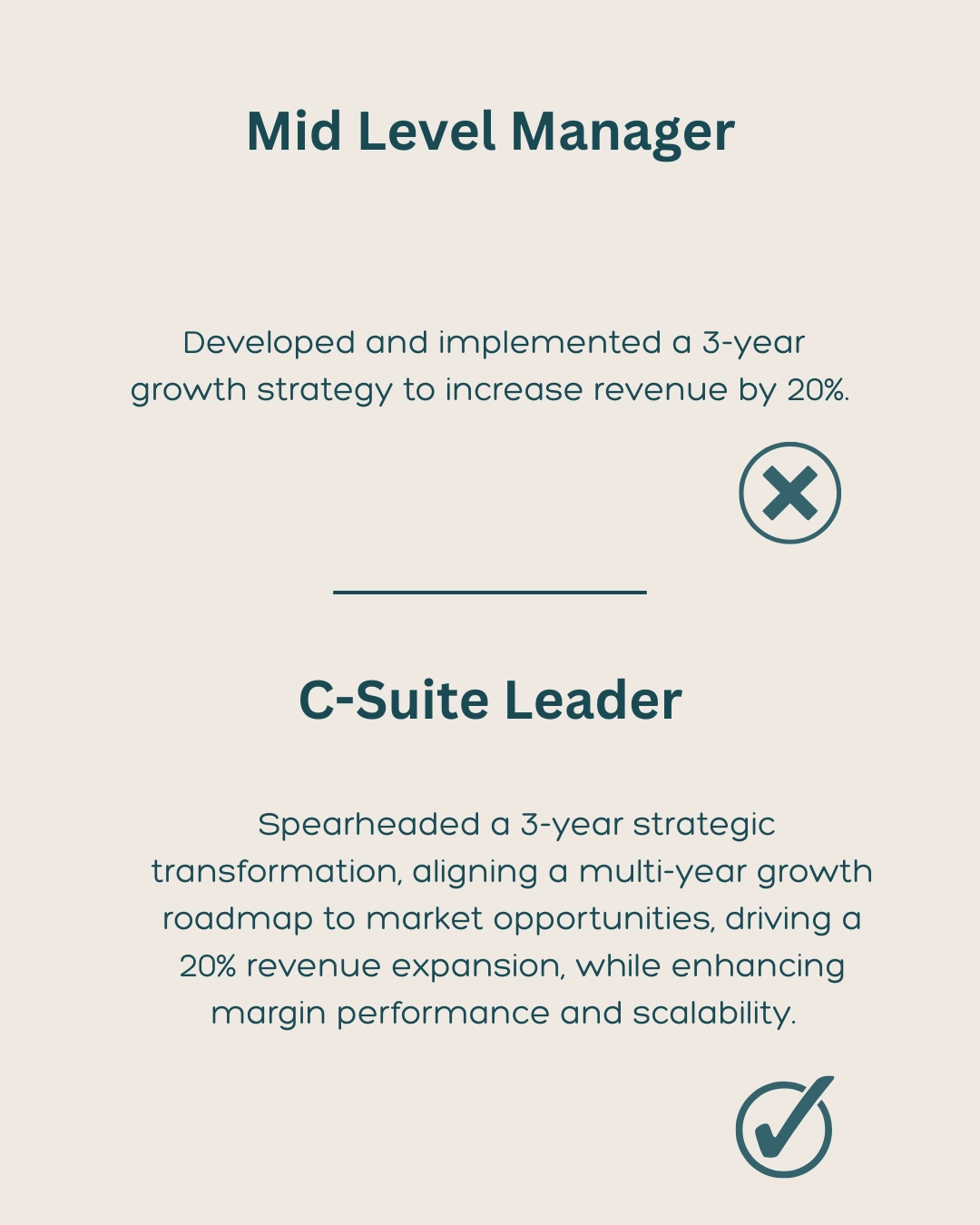
Developed -> Led with influence
Initiated -> Championed, pioneered, established the inaugural or launched
Bonus tip for your cover letter: As a sought-after executive, shift the tone in your cover letter from chasing roles to ‘I am interested in discussing further’ energy. If you need assistance writing a cover letter that captures recruiters’ attention, learn more about our cover letter writing services here.
Power of ‘re’
Remember, executives are transformative leaders. An easy way to elevate the tone of your executive resume is to think ‘re’, for example:
- Redefined
- Redeveloped
- Redesigned
- Restructured
- Realigned
- Reimagined
These all suggest shifting from a problem state to a transformative state, showcasing your leadership impact.
6. Look for leadership experience in your resume writer
The classic playground catch cry, ‘it takes one to know one,’ rings true in adulthood too. The best executive resume writers will have real-world industry experience as a leader or have partnered closely with them. The magic that spins your resume into gold happens in your consultation – particularly through the prompts that reveal your unique selling proposition, key expertise and highlights. Your resume writer must have a high-calibre understanding of business, gained from the inside, to know all the right questions to ask.
At Elevate Career Services, our team bring high-level industry experience to your resume, backed by formal qualifications including MBA, legal, marketing, communications and engineering qualifications. Meet the team here.
From easily overlooked to sought-after C-suiter
Your resume is more than a career summary – it’s a reflection of how you lead, influence, conceptualise and respond to changing markets with future-focused impact. With precision, beyond merely listing your skills and expertise, it must highlight the value only you can bring to the top job. To get your professional brand noticed for your next executive opportunity, explore our Resume Writing Services here or book a free discovery call directly with me.


